
By Money Signals Editorial Team
Money Signals researches borrowing behavior, debt psychology, budgeting systems, and financial decision-making to help readers better understand how loans, repayment structures, and long-term borrowing costs affect financial stability. Our goal is to simplify financial concepts into practical, realistic guidance that people can apply before making major money decisions.
Financial Disclaimer: This article is for informational purposes only and does not constitute financial advice. Loan decisions should be evaluated carefully based on your income, credit profile, financial goals, repayment ability, and overall financial situation.
Who This Guide Is For
This guide is especially useful if you are considering taking out a personal loan, auto loan, or other type of financing and want to understand what the numbers actually mean before committing. It is also useful for people comparing multiple borrowing options, evaluating monthly affordability, or trying to avoid underestimating the long-term cost of debt.
Many borrowers focus on one number first:
👉 “What is the monthly payment?”
That reaction is completely understandable because monthly affordability matters in everyday budgeting.
If the payment feels manageable, the loan may initially appear:
- Reasonable
- Affordable
- Easy to handle financially
However, focusing only on the monthly payment is also one of the biggest reasons people underestimate the true cost of borrowing.
A smaller monthly payment does not automatically mean:
- A cheaper loan
- A financially efficient loan
- A better long-term decision
In many cases, lower payments simply spread the debt across:
- More years
- More interest accumulation
- Higher total repayment overall
That is why loan calculators are important.
If you are trying to understand a loan calculator, the most important insight is this:
👉 A loan calculator is not just a payment estimator. It helps reveal the real long-term financial cost of borrowing before you commit to debt.
Try the Money Signals Loan Calculator
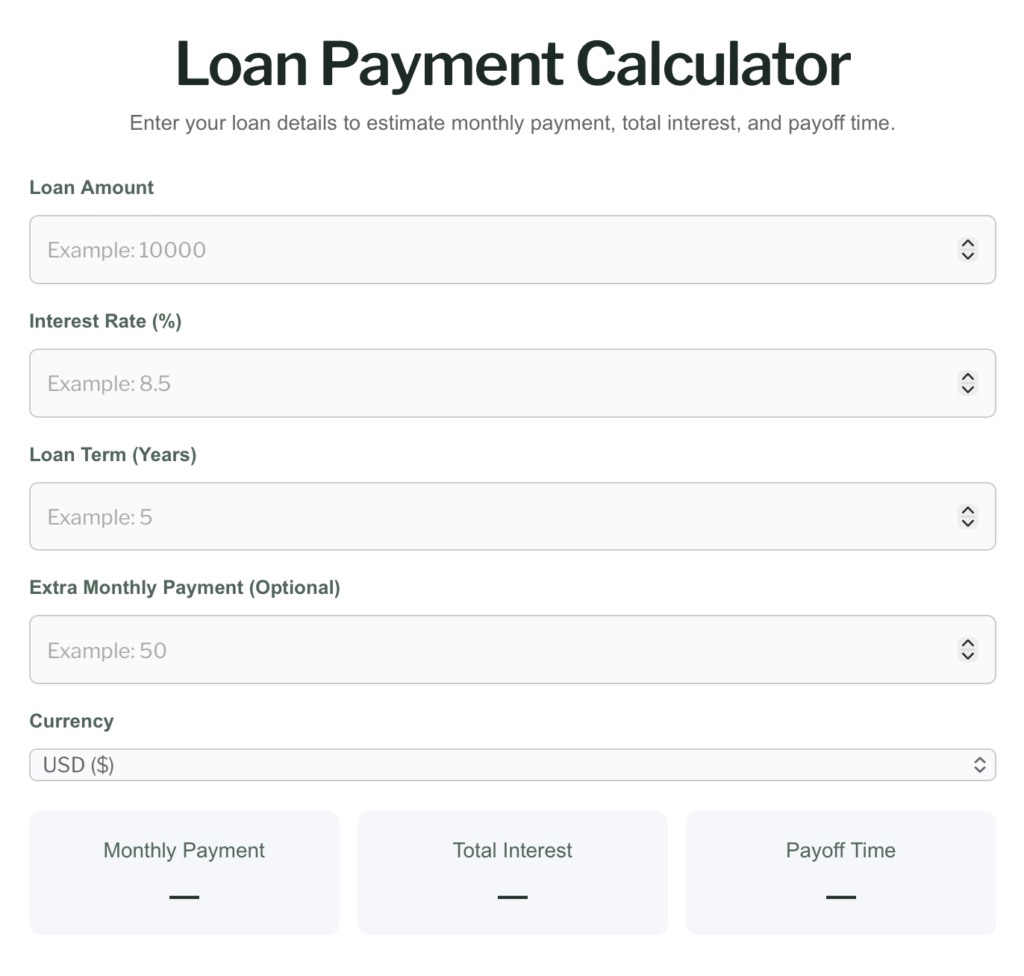
Before taking any loan, it helps to test different borrowing scenarios using a real calculator instead of relying only on advertised monthly payment estimates.
The Money Signals Loan Calculator allows you to estimate:
- Monthly payments
- Total interest paid
- Overall repayment amount
- The impact of different loan terms and interest rates
This is especially useful when comparing:
- Shorter versus longer repayment periods
- Different down payment amounts
- Multiple loan offers
- Interest rate changes
The calculator helps make borrowing decisions more visible before financial commitments become long-term obligations.
Introduction
Loans can make large purchases feel financially accessible very quickly.
Instead of paying thousands of dollars upfront, borrowing allows repayment over:
- Months
or - Years.
This flexibility can be extremely useful for situations involving:
- Transportation needs
- Emergency expenses
- Education costs
- Home-related expenses
- Debt consolidation
However, loans also create long-term financial obligations that are often underestimated emotionally.
One reason this happens is because loan offers are commonly marketed around:
- Low monthly payments
- Promotional financing offers
- “Affordable” repayment terms
These numbers attract attention because people naturally focus on:
👉 Immediate affordability.
The problem is that monthly payments only show part of the financial picture.
For example, a lender can lower monthly payments significantly simply by extending repayment across:
- More years
- Longer financing periods
At first glance, this can make a loan appear:
👉 Easier to manage emotionally.
But longer repayment terms often increase:
- Total interest paid
- Overall borrowing cost
- Long-term financial pressure
substantially.
Interest itself can also feel psychologically invisible because it accumulates gradually across many months or years.
Borrowers often notice:
- The monthly payment
while overlooking:
- The total repayment amount
That disconnect is one reason people underestimate how expensive borrowing can become over time.
That is where calculators become valuable.
A loan calculator transforms borrowing decisions from:
👉 “Can I make this payment?”
into:
👉 “What will this borrowing decision actually cost me over time?”
That shift creates much better financial awareness.
The goal is not avoiding all debt automatically.
The goal is understanding:
- The repayment structure
- The interest cost
- The long-term financial tradeoffs
before signing the loan agreement.
Why Loan Numbers Are Misleading Without Context
Loan offers often appear simple on the surface.
You see:
- A monthly payment
- An interest rate
- A repayment timeline
and the financing may initially feel straightforward.
But borrowing costs become much more complicated once long-term repayment is considered carefully.
One of the biggest reasons loans feel misleading is because lower monthly payments often create:
👉 A false sense of affordability.
A payment may feel comfortable because it fits within your current monthly budget.
However, that lower payment may exist only because repayment has been stretched across:
- More years
- More interest accumulation
- More total repayment overall
For example:
A five-year loan may produce a much lower monthly payment than a three-year loan.
But the five-year structure may also result in:
- Significantly more interest paid long-term.
This creates an important distinction between:
👉 Monthly affordability
and
👉 Total borrowing efficiency.
Many people naturally focus on short-term affordability because monthly expenses feel immediate and emotionally visible.
Borrowers often ask:
👉 “Can I afford this payment each month?”
before asking:
👉 “How much will this loan actually cost me overall?”
That short-term focus can lead to:
- Expensive borrowing decisions
- Excessive interest payments
- Reduced financial flexibility later
Interest contributes to the confusion because it accumulates slowly over time.
Instead of paying a large fee upfront, borrowers pay:
- Small additional costs
across - Many months or years.
As a result, the true cost often feels less visible emotionally.
Loan terms can also create artificial affordability.
A lender may reduce payments significantly simply by:
- Extending the repayment period.
While that may improve short-term cash flow, it can also increase:
- Total debt duration
- Total repayment cost
- Financial obligations extending further into the future
👉 Core insight: Loan calculators help reveal the full financial picture instead of focusing only on emotionally appealing monthly payment numbers.
What a Loan Calculator Actually Shows
A loan calculator organizes borrowing information into clearer financial estimates.
Its purpose is to help borrowers understand:
- Monthly payments
- Interest costs
- Total repayment amounts
before taking on debt.
The monthly payment estimate is usually the number people notice first.
The calculator estimates how much you will likely pay monthly based on:
- Loan amount
- Interest rate
- Repayment length
This helps evaluate whether the payment fits realistically within your budget.
However, one of the most important outputs is:
👉 Total projected interest paid.
This reveals:
- The true cost of borrowing money over time.
The calculator also estimates:
👉 Total repayment amount.
This equals:
Principal+InterestPrincipal+Interest
Many borrowers are surprised when the total repayment amount is significantly higher than:
- The original amount borrowed.
Loan calculators also allow scenario comparisons.
This means you can test:
- Different loan lengths
- Different interest rates
- Different borrowing amounts
to see how small changes affect long-term costs dramatically.
The Money Signals Loan Calculator is especially useful for comparing these tradeoffs before accepting financing.
The Key Inputs Explained
Loan calculators rely on several important variables.
The first major factor is:
👉 Loan amount.
This is the amount borrowed initially.
Larger borrowing amounts generally increase:
- Monthly payments
- Interest accumulation
- Total repayment cost
The second major factor is:
👉 Interest rate.
The interest rate determines the cost of borrowing money.
Higher interest rates increase:
- Monthly payments
- Total repayment amount
- Overall financing cost
Even relatively small differences in rates can create major long-term cost differences.
For example:
A loan with:
- 5% interest
may cost dramatically less than:
- The same loan at 10%.
Another major variable is:
👉 Loan term length.
The loan term refers to:
- How long repayment lasts.
Examples may include:
- Three years
- Five years
- Ten years
Longer repayment periods usually:
- Reduce monthly payments
while increasing:
- Total interest paid long-term.
Shorter repayment periods usually:
- Increase monthly payments
while reducing:
- Overall borrowing cost significantly.
The relationship between:
- Loan amount
- Interest rate
- Repayment time
ultimately determines:
👉 The real total cost of borrowing.
How to Use the Money Signals Loan Calculator Step-by-Step
Using the Money Signals Loan Calculator is relatively simple.
The real value comes from comparing scenarios thoughtfully instead of focusing only on the lowest payment possible.
Start by entering:
👉 The amount you expect to borrow.
Next, enter:
👉 The estimated interest rate or APR.
If available, APR is often more useful because it provides a broader estimate of borrowing cost.
Then select:
👉 The repayment term.
This refers to the number of months or years required for repayment.
Once these numbers are entered, the calculator estimates:
- Monthly payment amount
- Total interest paid
- Overall repayment cost
At this point, many borrowers focus primarily on:
👉 The monthly payment.
But the most important step is reviewing:
- Total interest
- Total repayment amount
because these numbers reveal the actual long-term financial impact.
The calculator becomes especially useful when comparing multiple scenarios.
For example:
You may discover that:
- Slightly higher monthly payments
can sometimes reduce: - Total loan cost dramatically.
That type of visibility helps borrowers make much more informed financial decisions before committing to long-term debt.
What the Results Actually Mean
The calculator results become valuable once you understand what they represent practically.
The monthly payment estimate primarily reflects:
👉 Short-term affordability.
It helps answer:
👉 “Can this fit within my current monthly budget?”
However, affordability alone does not determine whether a loan is financially efficient long-term.
Interest represents:
👉 The price paid for access to borrowed money.
Higher interest means:
- More money lost to financing over time.
Loan payments are usually divided between:
- Principal repayment
and - Interest charges.
Especially during the early stages of many loans, interest may consume a surprisingly large portion of each payment.
This means borrowers may make payments consistently while the actual loan balance decreases more slowly than expected initially.
Loan calculators help reveal these tradeoffs clearly.
Examples include:
- Lower monthly payments often mean longer debt obligations
- Shorter repayment terms often increase monthly pressure but reduce total borrowing cost
This broader perspective helps borrowers evaluate:
- Affordability
- Flexibility
- Long-term financial impact
instead of reacting emotionally to monthly payment numbers alone.
Common Borrowing Mistakes
Many borrowing mistakes happen because people focus too narrowly on immediate affordability.
One common mistake is automatically choosing the:
👉 Longest repayment term available.
Longer terms reduce monthly payments but often increase:
- Total interest dramatically.
Another common mistake is ignoring:
👉 Total repayment cost.
Some borrowers never calculate:
- How much the loan will cost overall.
This can create:
- Expensive long-term obligations
- Reduced future flexibility
- More financial pressure later
Another issue involves borrowing based solely on:
👉 Approval amount.
Being approved for a larger loan does not automatically mean:
- The loan fits comfortably within your long-term financial goals.
Some borrowers also overlook:
- Fees
- Insurance costs
- Variable interest structures
- Additional financing charges
which affect true borrowing cost substantially.
The biggest mistake is confusing:
👉 “I can technically make this payment”
with:
👉 “This loan is financially efficient and sustainable.”
How to Use This Before Taking a Loan
Loan calculators are most useful:
👉 Before committing to debt.
Before accepting financing, compare multiple repayment scenarios using the:
Money Signals Loan Calculator
Even relatively small differences in:
- Interest rates
or - Loan terms
can significantly affect:
- Total repayment cost
- Financial flexibility
- Long-term debt burden
It is also important to evaluate affordability realistically.
Instead of asking only:
👉 “Can I make this payment?”
also ask:
👉 “Will this payment reduce my financial flexibility too much?”
Loan payments affect:
- Emergency savings
- Budget flexibility
- Future financial goals
- Financial stress during unexpected situations
Opportunity cost matters too.
Money spent on:
- Interest
- Long repayment periods
- Financing charges
cannot simultaneously be used for:
- Savings
- Investing
- Debt reduction elsewhere
- Other financial priorities
The smartest borrowing decisions balance:
- Affordability
- Flexibility
- Long-term cost awareness
instead of focusing only on minimum monthly payments.
FAQs About Loan Calculators
Is a lower monthly payment always better?
Not necessarily. Lower monthly payments often mean longer repayment periods and higher total interest costs.
How does interest affect total loan cost?
Higher interest rates increase both monthly payments and total repayment amounts over time.
Should I choose a shorter repayment term?
Shorter terms often reduce total interest costs, though monthly payments may become higher.
Can I repay a loan early?
Many loans allow early repayment, though some lenders may charge prepayment penalties.
What is a good loan interest rate?
That depends on market conditions, credit history, loan type, repayment structure, and lender policies.
The Bottom Line
Loan calculators do more than estimate payments.
They help reveal:
- Monthly affordability
- Interest accumulation
- Total repayment cost
- Long-term financial tradeoffs
By making borrowing measurable, calculators help borrowers make:
- More informed financial decisions
- Better repayment evaluations
- Smarter long-term borrowing choices
The goal is not avoiding debt automatically.
It is understanding:
- The true cost
- The repayment structure
- The long-term impact
before committing.
Because once borrowing becomes measurable clearly, it becomes much easier to make smarter financial decisions with greater confidence and awareness.
Start Here (Simple Action Step)
Before accepting any loan offer:
- Open the Money Signals Loan Calculator
- Enter the loan amount, interest rate, and repayment term
- Compare multiple loan scenarios
- Review total interest—not just monthly payments
- Ask whether the full repayment cost still feels worthwhile long-term
👉 Sometimes the most important loan number is not the monthly payment—it is the total amount eventually repaid over time.
Related Articles
→ How to Use a Debt Payoff Calculator
Plan repayment timelines and compare payoff strategies clearly
→ How to Lower Recurring Bills Without Changing Everything
Free up monthly cash flow before taking on additional debt
→ How to Spot Bank Fees You Can Avoid
Identify hidden financial costs affecting your budget
Simple Insight to Remember
A loan calculator does not just estimate payments—it helps reveal the real long-term financial cost of borrowing before debt becomes a lasting financial obligation.