
By Money Signals Editorial Team
Money Signals researches income psychology, compensation structures, work-life financial balance, and practical financial decision-making to help readers better understand how money, time, and career choices interact in real life. Our goal is to simplify financial concepts into realistic and actionable insights people can apply immediately.
Financial Disclaimer: This article is for informational purposes only and does not constitute financial, tax, or career advice. Salary calculations vary depending on taxes, benefits, overtime, bonuses, work schedules, and compensation structures.
Who This Guide Is For
This guide is especially useful if you:
- Want to understand what your salary actually means hourly
- Are comparing job offers with different schedules or workloads
- Work overtime regularly and want to estimate your true hourly value
- Are evaluating freelance work or side hustles
- Want a clearer understanding of how your time translates into compensation
Many salaried employees know their annual income very well.
Far fewer understand what that salary actually translates to:
👉 Per hour worked.
That difference matters much more than many people initially realize.
When compensation is viewed only as:
- A yearly number
or - A monthly paycheck
it becomes difficult to evaluate:
- The true value of your time
- Whether overtime is financially worthwhile
- How demanding schedules affect compensation
- How different job opportunities compare realistically
A salary-to-hourly calculator helps make those relationships visible.
If you are trying to understand how a salary-to-hourly calculator works, the most important insight is this:
👉 Converting salary into hourly terms is not just a math exercise. It changes how you evaluate work, flexibility, time investment, and financial decisions overall.
Try the Money Signals Salary-to-Hourly Calculator
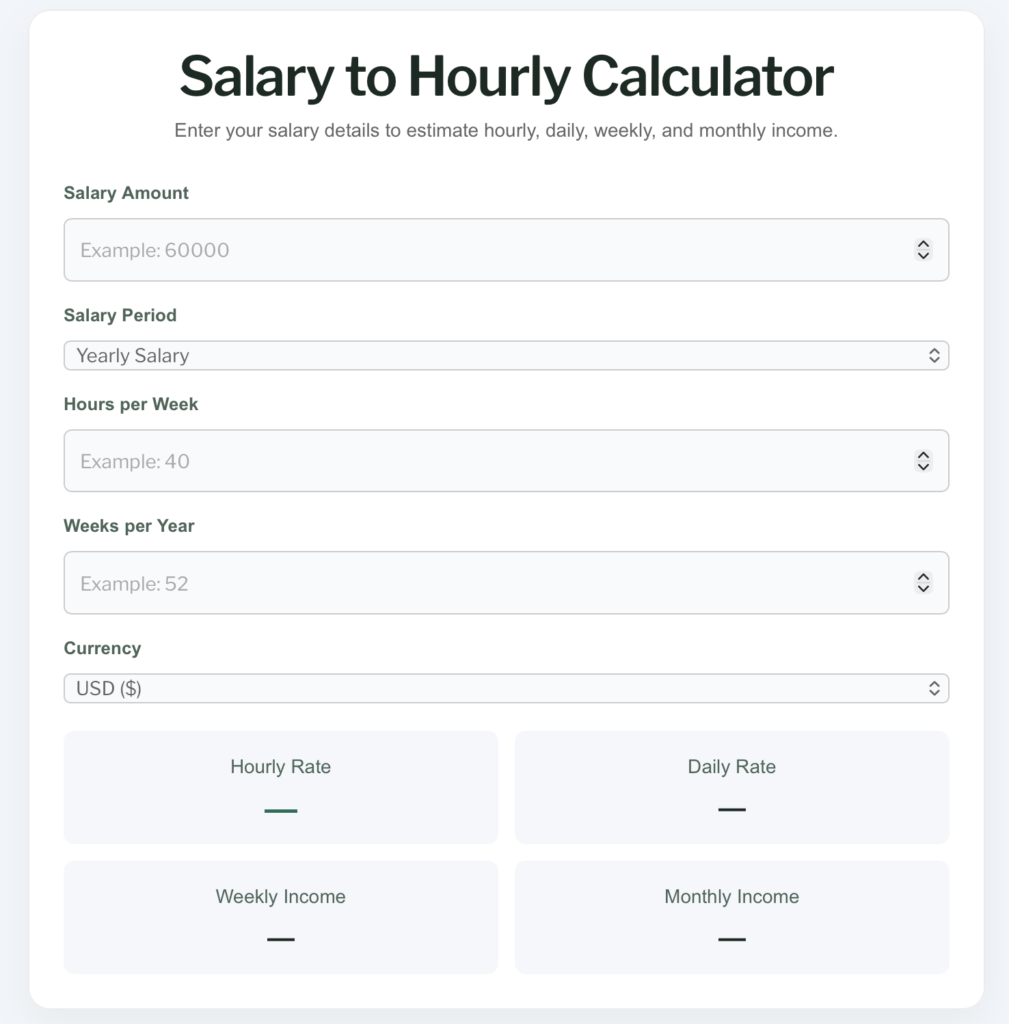
Before estimating your compensation manually, it helps to organize the numbers using a simple conversion tool.
The Money Signals Salary-to-Hourly Calculator helps estimate:
- Hourly equivalent pay
- Weekly and monthly income breakdowns
- The impact of work hours on compensation
- Realistic time-based income comparisons
The calculator is especially useful for:
- Comparing job opportunities
- Evaluating overtime impact
- Understanding work-life tradeoffs
- Comparing salaried jobs to freelance or hourly work
Seeing salary converted into hourly terms often changes how people think about:
- Time
- Workload
- Career decisions
- Financial priorities overall
because compensation becomes connected directly to:
👉 Time investment.
Introduction
Most people think about income in annual terms because that is how salaries are usually presented.
A job offer may advertise:
- $50,000 yearly
- $75,000 yearly
- $100,000 yearly
Those numbers feel straightforward on the surface.
But salary alone does not fully explain:
- How much time the job requires
- How demanding the workload may become
- How overtime affects compensation
- How your time is actually being exchanged for income
That is why salary conversion becomes useful.
A salary-to-hourly calculator translates:
👉 Abstract yearly income
into
👉 Time-based compensation.
That shift creates a much more practical perspective.
For example:
Two jobs may offer similar salaries while requiring very different:
- Work schedules
- Overtime expectations
- Commute demands
- Availability outside work hours
Without converting compensation into hourly terms, those differences can remain hidden.
This perspective also changes how people evaluate:
- Side hustles
- Freelance opportunities
- Additional overtime
- Career changes
- Opportunity cost
because income becomes connected directly to:
👉 Hours worked.
Another important issue is that many salaried employees underestimate how much unpaid time affects effective compensation.
Examples include:
- Evening emails
- Weekend tasks
- Long commutes
- Mandatory meetings
- Off-hours availability
When total work-related time increases while salary remains fixed:
👉 Effective hourly value decreases.
That does not automatically mean salaried work is “bad.”
It simply means compensation becomes clearer once:
👉 Time is included in the equation.
The goal of salary conversion is not obsessing over every hour financially.
The goal is understanding compensation clearly enough to make:
- Better career decisions
- Better time-management choices
- Better financial comparisons overall
Why Converting Salary to Hourly Matters
Many people think primarily in terms of:
- Annual income
or - Monthly take-home pay.
But time is one of the most important parts of compensation.
Without understanding how much income is effectively earned per hour, it becomes difficult to evaluate:
- Workload expectations
- Overtime demands
- Schedule flexibility
- Opportunity cost
- Alternative income opportunities
clearly and realistically.
One reason salary numbers can feel psychologically misleading is because yearly income often sounds larger emotionally when presented annually.
For example:
A salary of:
👉 $60,000 yearly
creates a very different emotional impression than viewing it as:
👉 An hourly equivalent.
Converting salary into hourly terms creates:
- Better perspective
- Easier comparison between opportunities
- Increased awareness around time value
This becomes especially important when evaluating:
👉 Work-life balance.
Two jobs offering similar salaries may create completely different lifestyles depending on:
- Hours worked
- Schedule demands
- Overtime expectations
- Flexibility
- Commute time
Hourly conversion helps make those tradeoffs more visible.
It also improves comparisons between:
- Salaried jobs
- Freelance work
- Hourly employment
- Side hustles
- Contract opportunities
because compensation becomes easier to evaluate using:
👉 A shared time-based reference point.
People often realize:
- Some purchases represent many hours of labor
- Certain jobs demand more time than the salary initially suggests
- Some side hustles pay less effectively than expected once time investment is included
This awareness often changes:
- Spending decisions
- Career evaluation
- Time management
- Financial priorities overall
How Salary Conversion Works
At its core, salary conversion is relatively simple mathematically.
A salary-to-hourly calculator estimates:
👉 How much income is earned per hour worked.
Most calculators begin with:
- Annual salary
and - Estimated yearly work hours.
The most common assumption is:
- 40 work hours weekly
- 52 weeks yearly
This produces:
40×52=208040×52=2080
or approximately:
👉 2,080 work hours annually.
A simplified salary conversion formula looks like this:
Hourly Rate=Annual SalaryHours Worked Per YearHourly Rate=Hours Worked Per YearAnnual Salary
For example:
Annual salary:
👉 $60,000
Estimated yearly hours:
👉 2,080
The estimated hourly calculation becomes:
600002080≈28.85208060000≈28.85
Estimated hourly rate:
👉 About $28.85 hourly.
The math itself is relatively simple.
The more important issue is understanding what the number actually represents.
Many calculators assume:
- Standard schedules
- Consistent hours
- No additional unpaid time
But real-world work situations are often more complicated.
The calculation changes significantly when:
- Overtime becomes common
- Workweeks regularly exceed 40 hours
- Additional unpaid work exists
- Long commutes become part of the routine
That is why hourly estimates are useful:
👉 But not always perfectly exact.
The Money Signals Salary-to-Hourly Calculator simplifies this process by organizing:
- Salary estimates
- Work hours
- Compensation breakdowns
into a clearer time-based compensation overview.
Factors That Affect Your Real Hourly Value
Your official hourly equivalent and your real hourly compensation are not always identical.
One of the biggest factors affecting hourly value is:
👉 Overtime.
Many salaried employees regularly work beyond standard schedules through:
- Evening communication
- Weekend work
- Additional meetings
- Extended shifts
- Off-hours responsibilities
If salary remains fixed while work hours increase:
👉 Effective hourly compensation decreases.
For example:
A $60,000 salary based on:
- Standard 40-hour weeks
produces a much stronger hourly equivalent than:
- The same salary requiring regular 55-hour weeks.
Another overlooked factor is unpaid work-related time.
Some responsibilities are not directly compensated, including:
- Commutes
- Preparation work
- Mandatory events
- Constant availability outside work hours
Even though these hours may not appear officially on paper, they still affect:
- Lifestyle quality
- Personal time
- Energy levels
- Effective compensation value
Benefits also matter significantly.
Salary alone does not always reflect:
👉 Total compensation value.
Some jobs provide:
- Health insurance
- Retirement matching
- Paid leave
- Flexible scheduling
- Remote work options
These benefits may improve overall compensation quality even if hourly estimates initially appear similar numerically.
Taxes and deductions matter too.
Gross salary calculations are not the same as:
👉 Spendable income.
Taxes, insurance deductions, and retirement contributions reduce:
- Actual take-home pay
- Real spending flexibility
That is why hourly calculations should always be viewed:
👉 As estimates—not perfect measurements.
How to Use the Money Signals Salary-to-Hourly Calculator
Using the Money Signals Salary-to-Hourly Calculator is relatively straightforward.
Start by entering:
👉 Your annual salary or estimated yearly income.
Most people begin with:
- Gross yearly income
before: - Taxes and deductions.
Next, estimate:
👉 Your actual work hours realistically.
This step matters more than many people initially realize.
Many people first enter:
- Official scheduled hours.
But more realistic estimates may also include:
- Overtime
- Evening communication
- Weekend responsibilities
- Additional unpaid work time
Using realistic work hours produces a more accurate estimate of:
👉 Your true hourly compensation.
After entering salary and estimated work hours, the calculator estimates:
- Hourly equivalent income
- Weekly income breakdowns
- Monthly income estimates
At this point, the calculator becomes useful for:
- Comparing schedules
- Evaluating overtime impact
- Comparing job opportunities
- Analyzing side hustle potential
The calculator becomes most valuable when:
👉 The assumptions reflect your real schedule honestly.
If work hours are underestimated, hourly compensation estimates become artificially inflated.
That is why realistic time tracking improves decision-making significantly.
What Your Hourly Rate Actually Reveals
The hourly number itself is not the final goal.
The insight behind the number matters much more.
Understanding hourly value helps answer:
👉 “What is my time actually worth financially?”
That perspective changes how people evaluate:
- Overtime
- Freelance opportunities
- Purchases
- Career decisions
- Side hustles
Hourly calculations also reveal:
👉 Opportunity cost.
Opportunity cost refers to:
- What you give up when spending time one way instead of another.
Examples include:
- Taking additional overtime
- Starting a side hustle
- Switching jobs
- Accepting demanding schedules
Hourly comparisons make these tradeoffs easier to evaluate realistically.
This perspective is especially useful when comparing:
- Income opportunities
- Workload demands
- Flexibility
- Lifestyle impact
Sometimes:
- Higher-paying jobs demand dramatically more time and stress than initially expected.
Hourly conversion helps reveal whether:
👉 The tradeoff actually feels worthwhile personally.
Common Mistakes When Evaluating Salary
One common mistake is ignoring:
👉 Overtime and hidden work hours.
A salary may initially appear attractive until:
- Long workweeks
- Weekend work
- Constant availability
reduce effective hourly compensation substantially.
Another mistake is comparing only:
👉 Gross salary numbers.
Gross salary estimates do not reflect:
- Taxes
- Deductions
- Insurance costs
- Retirement contributions
which affect take-home income significantly.
Some people also ignore:
- Schedule flexibility
- Remote work advantages
- Benefits
- Reduced commuting time
even though these factors strongly affect:
- Lifestyle quality
- Stress levels
- Work-life balance
Salary comparison works best when:
👉 Compensation, flexibility, workload, and time demands are evaluated together—not separately.
FAQs About Salary-to-Hourly Calculations
Does salary include benefits?
Most salary calculators focus primarily on direct pay, though benefits can significantly affect total compensation value.
What if I work overtime regularly?
Additional unpaid hours reduce your effective hourly rate because salary remains fixed while total work time increases.
How do taxes affect hourly estimates?
Gross hourly calculations do not reflect taxes or deductions, which reduce actual take-home income.
Can I compare jobs using hourly conversion?
Yes. Hourly conversion helps compare compensation, schedules, flexibility, and workload more realistically.
Is hourly pay always more accurate than salary?
Not necessarily. It is simply a different perspective that helps connect compensation more directly to time investment.
The Bottom Line
A salary-to-hourly calculator does more than convert numbers.
It changes perspective.
By translating annual salary into:
- Hourly compensation
- Time-based value
- Real-world workload impact
the calculator helps reveal:
- How work hours affect compensation
- How opportunities compare realistically
- How time and money interact in everyday life
The Money Signals Salary-to-Hourly Calculator helps transform salary from:
👉 An abstract yearly number
into
👉 A clearer understanding of what your time and effort are actually producing financially.
The goal is not reducing your career to a single number.
It is understanding compensation clearly enough to make:
- Better financial decisions
- Better career comparisons
- Better work-life balance evaluations
Because once income becomes connected clearly to time, financial decisions often become much more intentional overall.
Start Here (Simple Action Step)
Take 15–20 minutes this week:
- Estimate your real average weekly work hours
- Open the Money Signals Salary-to-Hourly Calculator
- Compare your official schedule versus your actual work time
- Evaluate whether your current compensation still feels aligned with your time and energy investment
👉 Sometimes the most valuable financial insight comes from understanding not only how much you earn—but how your time is actually being exchanged for that income.
Related Articles
→ Beginner-Friendly Ways to Make Extra Money
Explore realistic low-barrier income opportunities
→ How to Compare Side Hustles Before Starting
Evaluate income opportunities based on time, effort, and sustainability
→ How to Find Where Your Money Is Disappearing
Improve spending awareness before increasing income streams
Simple Insight to Remember
A salary-to-hourly calculator does not just convert income into numbers—it helps translate work, time, and compensation into a clearer understanding of what your effort is actually worth in real life.