
By Money Signals Editorial Team
Money Signals researches budgeting behavior, spending psychology, recurring expense systems, and sustainable money management strategies to help readers build practical financial habits that work in real life. Our goal is to simplify personal finance into systems that feel realistic, flexible, and sustainable long-term.
Financial Disclaimer: This article is for informational purposes only and does not constitute financial advice. Budgeting methods should always be adjusted based on your income, expenses, financial obligations, and personal goals.
Who This Guide Is For
This guide is useful for people who want to understand where their money is actually going each month but feel overwhelmed by budgeting. It is especially helpful if you have tried budgeting before and struggled to stay consistent, feel financially disorganized, or want a simpler system for understanding your income and expenses without relying on complicated spreadsheets.
Many people assume budgeting fails because they lack discipline.
In reality, budgeting often fails because finances feel emotionally overwhelming and difficult to organize clearly.
Income comes in from different sources. Bills are paid at different times. Small purchases happen constantly throughout the month. Subscriptions renew automatically in the background. Unexpected expenses appear without warning.
Over time, money can begin to feel:
- Reactive
- Difficult to track
- Emotionally stressful
- Hard to organize mentally
That confusion causes many people to rely on:
- Estimates
- Memory
- “General feelings” about spending
instead of actual financial visibility.
If you are trying to learn how to use a budget calculator, the most important insight is this:
👉 A budget calculator is not designed to restrict your life. It is designed to help you understand your financial reality more clearly so you can make better decisions with less stress.
Try the Money Signals Budget Calculator
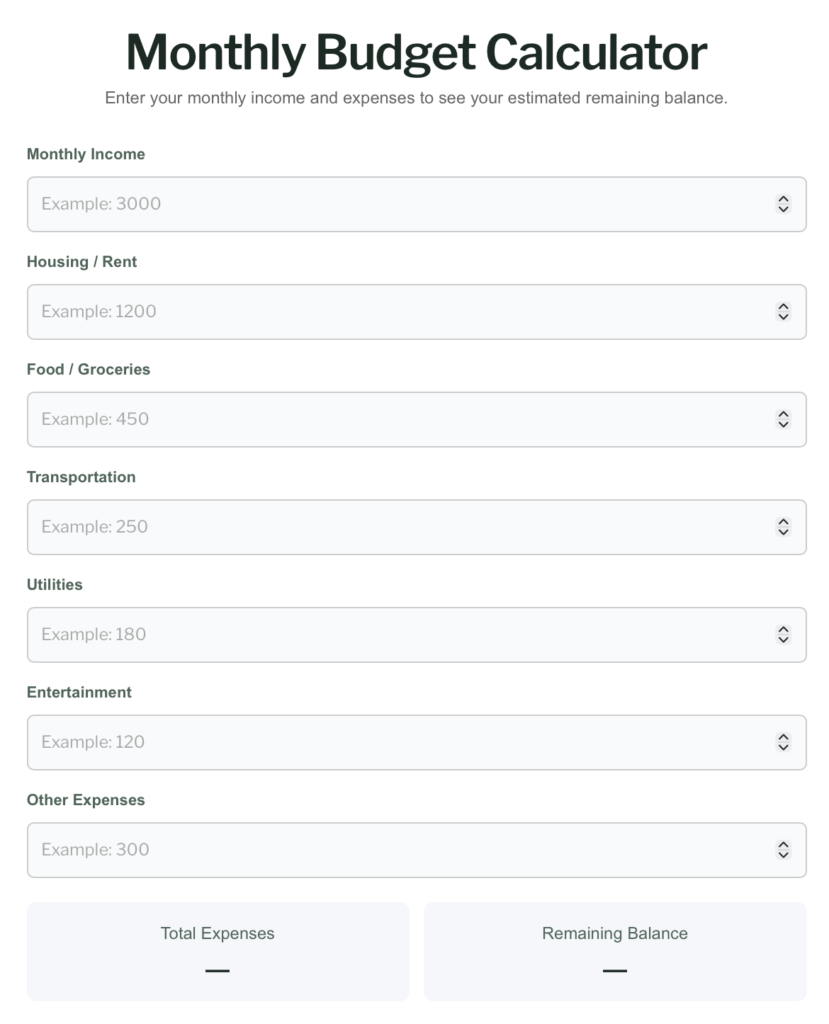
Before creating a budget manually, it helps to organize your finances using a simple structured tool.
The Money Signals Budget Calculator helps you estimate:
- Monthly income
- Essential expenses
- Spending categories
- Savings potential
- Budget surplus or deficit
The calculator is designed to make budgeting feel:
- Simpler
- More visual
- Less overwhelming
especially for beginners who want a realistic overview of their finances without building complicated spreadsheets from scratch.
It is especially useful for:
- Identifying spending patterns
- Estimating how much money remains after bills
- Finding areas where expenses may be too high
- Understanding whether your current budget is sustainable long-term
Introduction
One reason budgeting feels emotionally difficult is because money often feels fragmented and difficult to visualize clearly.
Financial activity happens constantly:
- Automatic payments process quietly
- Small purchases blend together
- Variable expenses change monthly
- Recurring subscriptions accumulate gradually
Without structure, it becomes difficult to answer basic financial questions such as:
- How much am I actually spending each month?
- Why does my balance disappear faster than expected?
- Which categories are creating the most pressure?
- How much room do I realistically have to save?
That lack of visibility creates stress because finances begin to feel:
👉 Reactive instead of intentional.
Many people avoid budgeting entirely because they associate it with:
- Restriction
- Financial guilt
- Constant monitoring
- Feeling “bad” with money
Others assume budgeting requires:
- Complex spreadsheets
- Obsessive tracking
- Extreme financial discipline
In reality, a good budget system is supposed to create:
- Clarity
- Awareness
- Better decision-making
- Reduced financial confusion
—not punishment.
That is where budget calculators become useful.
A calculator helps organize:
- Income
- Bills
- Spending categories
- Financial obligations
into a clearer financial overview.
Instead of relying on memory or emotional impressions, you begin working with:
👉 Actual numbers.
Once spending becomes visible:
- Financial decisions become easier to evaluate
- Spending leaks become easier to identify
- Saving opportunities become easier to spot
- Budgeting feels less emotionally chaotic overall
The goal is not building a perfect budget immediately.
The goal is understanding your financial situation clearly enough to improve it gradually and consistently over time.
What a Budget Calculator Actually Does
A budget calculator is a financial organization tool that compares:
👉 Income
against
👉 Expenses.
Its purpose is not to judge your spending.
Its purpose is to show:
- What money is coming in
- What money is going out
- What remains afterward
This creates a clearer picture of your current financial situation.
The Money Signals Budget Calculator organizes expenses into categories so you can identify:
- Which costs are fixed
- Which expenses fluctuate
- Which categories may need adjustment
This visibility is important because many people underestimate:
- Dining-out spending
- Subscription overlap
- Convenience purchases
- Irregular expenses
until they see the full numbers organized together.
One of the most important outputs from a budget calculator is whether your finances currently produce:
👉 A surplus
or
👉 A deficit.
A surplus means:
Income>ExpensesIncome>Expenses
This creates room for:
- Saving
- Debt reduction
- Emergency fund growth
- Financial flexibility
A deficit means:
Expenses>IncomeExpenses>Income
This indicates spending may currently be exceeding sustainable income levels.
That does not mean failure.
It simply means visibility has revealed areas needing attention.
Why Budget Calculators Improve Financial Awareness
Most people already know their bills generally.
What they often do not fully see is:
- How spending categories compare to income
- How recurring charges accumulate
- How variable spending changes monthly
- How much flexibility actually exists after bills are paid
Budget calculators help replace:
👉 Guesswork
with
👉 Measurable visibility.
That visibility matters because financial uncertainty often creates emotional stress.
Without structure, many people experience the feeling:
👉 “I make money, but I never fully understand where it goes.”
That uncertainty can create:
- Financial anxiety
- Difficulty saving
- Reduced confidence
- Poor long-term planning
Once spending patterns become visible, financial decisions become easier to evaluate realistically.
Budgeting also becomes less emotionally overwhelming because:
👉 The numbers stop feeling vague.
Instead of relying on assumptions, you begin working from a clearer understanding of your actual financial situation.
What You Need Before Using a Budget Calculator
A budget calculator is most useful when the information entered is reasonably accurate.
Before starting, gather your:
- Monthly take-home income
- Major recurring bills
- Average variable spending
- Debt payments
- Savings contributions
For budgeting purposes, net income is usually more useful than gross income because it reflects:
👉 Actual spendable money after deductions.
You should also estimate variable spending categories realistically.
These may include:
- Groceries
- Dining out
- Entertainment
- Transportation
- Shopping
- Personal spending
One common budgeting mistake is underestimating variable expenses because:
- Small purchases often feel insignificant individually.
However, these smaller transactions accumulate quickly over time.
It is also important to account for irregular expenses such as:
- Car maintenance
- Medical costs
- Annual subscriptions
- Holiday spending
Even though these are not monthly, they still affect long-term budgeting significantly.
The goal is not perfect precision.
The goal is creating:
👉 A realistic enough financial picture to improve decision-making consistently over time.
How to Use the Money Signals Budget Calculator
Using the Money Signals Budget Calculator is relatively straightforward.
Start by entering your:
👉 Monthly take-home income.
If your income fluctuates monthly, use a conservative average based on recent months instead of estimating optimistically.
Next, enter your recurring fixed expenses such as:
- Housing
- Utilities
- Insurance
- Minimum debt payments
- Phone bills
- Internet costs
These are usually the least flexible categories financially.
After that, estimate your variable spending categories.
This includes areas such as:
- Food
- Transportation
- Entertainment
- Shopping
- Personal expenses
The calculator then compares:
👉 Total income
against
👉 Total expenses.
This reveals whether your budget currently produces:
- A surplus
or - A deficit.
At this point, many people experience their first major financial awareness moment.
The calculator often reveals:
- Hidden spending patterns
- Subscription overlap
- Overspending categories
- Budget imbalances
- Reduced financial flexibility
That awareness is the purpose of the process.
The next step is identifying where realistic improvements can happen.
Focus first on:
- Large recurring expenses
- Obvious spending leaks
- Categories that provide little value relative to cost
Avoid trying to optimize everything immediately.
Small sustainable improvements usually work much better long-term than aggressive short-term budgeting attempts.
How to Interpret Your Results Realistically
The calculator itself does not solve financial problems automatically.
Understanding the results is what creates value.
If your budget shows a surplus, that means:
Income−Expenses>0Income−Expenses>0
This creates room for:
- Saving
- Investing
- Debt reduction
- Increased flexibility
Even relatively small surpluses matter financially over time because repeated consistency compounds gradually.
If your budget shows a deficit, that means:
Expenses−Income>0Expenses−Income>0
This indicates current spending may not be sustainable long-term without adjustments.
That does not mean:
👉 You failed financially.
It means:
👉 The numbers have identified areas that need attention.
Budgeting works best when you focus on:
- Patterns
- Trends
- Repeated habits
instead of obsessing over isolated imperfect months.
For example, the calculator may reveal:
- Food spending consistently exceeding expectations
- Subscription duplication
- Convenience spending spikes
- Rising recurring costs
These patterns often matter more financially than occasional isolated purchases.
Common Budgeting Mistakes to Avoid
One of the most common budgeting mistakes is creating:
👉 Unrealistic “fantasy budgets.”
Examples include:
- Unrealistically low grocery estimates
- Zero entertainment spending
- Ignoring actual spending habits completely
Budgets only work when they reflect:
👉 Real behavior reasonably accurately.
Another common mistake is trying to optimize everything immediately.
Aggressive budgeting often creates:
- Burnout
- Frustration
- Budget abandonment
Small gradual adjustments are usually much more sustainable.
Many people also ignore irregular expenses completely.
Costs such as:
- Car repairs
- Holidays
- Medical expenses
- Annual renewals
still affect financial stability even if they are not monthly.
Ignoring them creates surprise financial pressure later.
Budgeting should also not become:
👉 A guilt system.
The purpose of budgeting is:
- Better awareness
- Better decisions
- Reduced financial confusion
- More intentional spending
not emotional punishment.
How to Build a Sustainable Budget Long-Term
The best budget is not:
👉 The strictest budget possible.
It is:
👉 The budget you can realistically maintain consistently.
Good budgeting systems allow room for:
- Real life
- Unexpected expenses
- Imperfect months
- Moderate flexibility
Budgets that feel emotionally exhausting usually become difficult to sustain long-term.
That is why flexibility matters.
The Money Signals Budget Calculator works best when used regularly as:
- A financial awareness tool
- A spending review system
- A decision-making aid
—not as a perfection tracker.
As financial awareness improves, many people naturally begin:
- Spending more intentionally
- Reducing low-value expenses
- Saving more consistently
- Feeling less financially overwhelmed overall
FAQs About Budget Calculators
Should I use net income or gross income?
Net income is usually more realistic because it reflects actual spendable money after deductions.
How often should I update my budget?
Monthly reviews are common, though weekly check-ins may improve awareness significantly.
What if my income changes monthly?
Use a conservative average based on recent income patterns instead of overestimating future earnings.
Do I need to track every expense perfectly?
No. The goal is awareness and pattern recognition—not obsessive financial perfection.
Can a budget calculator replace budgeting apps?
A calculator helps organize and visualize finances, while budgeting apps may provide more advanced ongoing tracking features.
The Bottom Line
Budgeting becomes much less stressful once money stops feeling vague and disconnected.
A budget calculator helps create:
- Structure
- Financial visibility
- Better awareness
- More intentional decision-making
by organizing:
- Income
- Expenses
- Spending patterns
into a clearer picture of your financial reality.
The goal is not building a perfect budget overnight.
It is understanding your finances clearly enough to make:
👉 Better decisions consistently over time.
Because financial control usually begins with:
👉 Financial visibility.
Start Here (Simple Action Step)
Take 20–30 minutes this week:
- Gather your recent income and expense information
- Open the Money Signals Budget Calculator
- Enter realistic numbers based on your actual spending habits
- Identify one category that feels higher than expected
- Make one small adjustment instead of trying to optimize everything immediately
👉 Small improvements in financial awareness often create meaningful long-term progress surprisingly quickly.
Related Articles
→ How to Find Where Your Money Is Disappearing
Identify hidden spending patterns and recurring financial leaks
→ How to Audit Your Subscriptions in 30 Minutes
Reduce recurring expenses through a simple review system
→ Realistic Ways to Save $100 This Month
Practical strategies to improve cash flow without extreme budgeting
Simple Insight to Remember
A budget calculator does not exist to judge your spending—it exists to make your financial reality visible enough to improve intentionally over time.