
By Money Signals Editorial Team
Money Signals researches saving behavior, investing psychology, long-term wealth building, and practical financial planning strategies to help readers better understand how consistent financial habits create long-term financial stability. Our goal is to simplify financial concepts into realistic and understandable guidance people can apply gradually over time.
Financial Disclaimer: This article is for informational purposes only and does not constitute financial or investment advice. Investment returns, savings growth, and interest rates vary depending on market conditions, financial products, and account types. Future returns are never guaranteed.
Who This Guide Is For
This guide is especially useful if you:
- Want to understand how compound interest actually works
- Feel confused by phrases like “interest on interest” or “compound growth”
- Want to estimate long-term savings growth realistically
- Are beginning to save or invest for the future
- Want to understand why starting early financially matters so much
Compound interest is one of the most important concepts in personal finance.
It is also one of the most misunderstood.
Many people hear phrases such as:
- “Make your money work for you”
- “Compound growth”
- “Interest on interest”
without fully understanding what those ideas actually mean in real life.
Part of the confusion comes from the fact that compound growth does not always feel dramatic initially.
In the beginning:
- Growth can appear slow
- Progress may feel small
- Results may not look impressive immediately
That delayed acceleration is exactly what makes compound interest powerful over time.
If you are trying to understand a compound interest calculator, the most important insight is this:
👉 Compound interest is less about getting rich quickly and more about understanding how small consistent growth compounds gradually over long periods of time.
Try the Money Signals Compound Interest Calculator
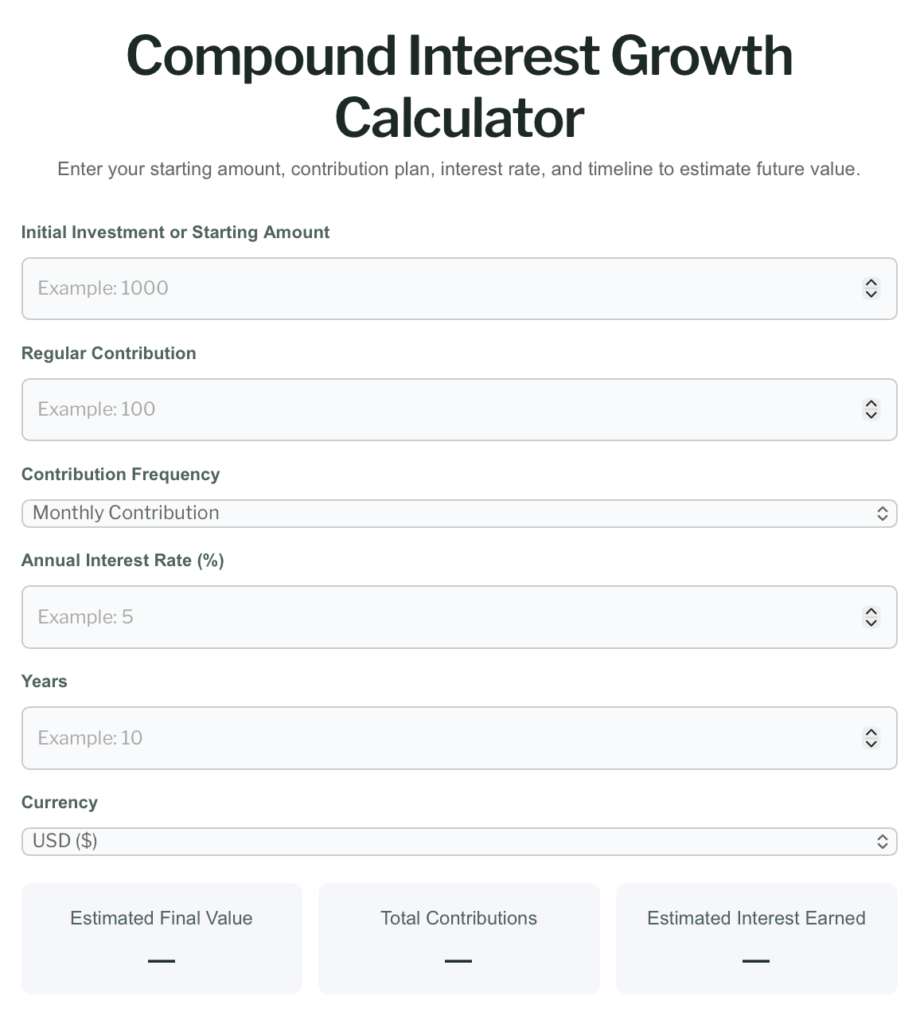
Before trying to estimate future growth mentally, it helps to organize the numbers using a structured tool.
The Money Signals Compound Interest Calculator helps estimate:
- Long-term savings growth
- Future account balances
- The impact of recurring contributions
- The effect of different interest or return rates
- How time affects compound growth
The calculator is especially useful for:
- Retirement planning
- Savings goals
- Investment projections
- Long-term financial planning
- Understanding the value of starting early
One of the biggest benefits of using a calculator is visibility.
Compound growth is difficult to visualize mentally because growth accelerates gradually over time.
The calculator helps connect:
👉 Present-day saving behavior
with
👉 Long-term financial outcomes.
Introduction
One reason compound interest feels difficult to appreciate emotionally is because people naturally focus on:
👉 Immediate results.
Compound growth rewards something very different:
- Patience
- Consistency
- Long-term thinking
That creates a psychological disconnect.
Most people expect growth to behave:
👉 Linearly.
For example:
- Save $100 monthly
- Expect results to increase steadily at the same pace
But compound growth behaves differently.
Over time:
👉 Growth itself begins generating additional growth.
That creates acceleration.
In the beginning, progress may feel:
- Slow
- Underwhelming
- Difficult to notice
This causes many people to underestimate:
- The importance of starting early
- The value of consistency
- The impact of long-term repetition
Another issue is that many people assume:
👉 Small contributions cannot matter significantly.
But compound growth changes the impact of repeated contributions over time.
Even relatively modest savings habits may become meaningful when:
- Continued consistently
- Given enough time to compound
That is why compound interest matters so much financially.
The goal is not chasing unrealistic overnight wealth.
The goal is understanding how:
- Time
- Repetition
- Growth
work together gradually to improve financial outcomes over long periods.
What Compound Interest Actually Means
Compound interest means:
👉 Earning growth not only on your original money
but also
👉 On previously earned growth.
This is why compound interest is often described as:
👉 “Interest on interest.”
That distinction matters because compound growth behaves very differently from simple interest.
With simple interest:
- Growth occurs only on the original principal amount.
With compound growth:
- Growth occurs on:
- The original amount
- Previously earned interest
- Accumulated gains over time
This creates:
👉 Accelerating growth.
For example:
If savings generate interest and the interest remains invested, future growth calculations are based on:
- A larger balance each period.
Over time, this creates:
- Faster accumulation
- Larger future balances
- Stronger long-term growth potential
Time plays a major role in this process.
The longer money remains invested or saved:
👉 The more opportunities compounding has to repeat.
This is one reason long-term investing strategies often emphasize:
- Starting early
- Staying consistent
- Remaining invested long enough for growth to accumulate gradually
Compound growth becomes even stronger when:
👉 Additional contributions are added consistently.
Examples include:
- Monthly savings deposits
- Retirement contributions
- Recurring investment contributions
The important principle is that compound growth rewards:
- Time
- Consistency
- Patience
much more than short-term intensity.
Why Time Matters So Much in Compound Growth
Time is one of the most important variables in compound interest.
In many situations:
👉 Time matters more than people initially expect.
One reason is because compounding accelerates gradually instead of immediately.
During the early years:
- Growth may appear relatively small
But over longer periods:
- Interest begins generating increasingly larger amounts of additional growth.
This creates:
👉 Exponential acceleration over time.
For example:
Someone who starts saving earlier may contribute less money overall while still potentially ending with:
- Larger long-term growth
because the money had:
👉 More time to compound.
This is why delaying saving or investing can become expensive long-term even when income increases later.
People often assume:
👉 “I will save more aggressively later.”
But compound growth rewards:
- Earlier consistency
more than: - Delayed intensity.
This does not mean starting late is pointless.
Consistency still matters significantly.
But the calculator helps reveal how strongly:
- Time amplifies growth repeatedly over long periods.
The Money Signals Compound Interest Calculator helps visualize this effect much more clearly than mental estimates alone.
How a Compound Interest Calculator Works
A compound interest calculator estimates:
👉 How money may grow over time.
It organizes several financial variables together to project:
- Potential future balances
- Contribution impact
- Long-term growth estimates
The calculator typically uses:
- Starting balance
- Contribution amounts
- Estimated interest or return rate
- Time horizon
to estimate future growth.
For example:
If someone invests:
- $100 monthly
over:
- 20 years
with consistent compound growth, the future balance may become significantly larger than:
👉 Total contributions alone.
The calculator does not predict:
👉 Exact future returns.
Especially with investing, future market performance is never guaranteed.
Instead, calculators provide:
👉 Illustrative projections
based on the assumptions entered.
This is important because compound growth is difficult to estimate mentally.
The calculator helps make:
- Long-term financial consequences
- Growth acceleration
- Contribution impact
much easier to visualize.
One of the most useful insights is how small changes in:
- Contribution amounts
- Time horizon
- Return assumptions
can dramatically affect future outcomes.
The Most Important Inputs Explained
Compound interest calculators rely on several major variables.
Understanding these inputs helps make the projections more meaningful.
The first variable is:
👉 Initial amount (principal).
This refers to:
- The starting balance.
Examples include:
- Initial savings
- Investment balances
- Deposit amounts
Larger starting balances create:
- More initial growth potential.
However, small beginnings still matter because:
👉 Compound growth rewards consistency over time.
The second major variable is:
👉 Ongoing contributions.
Many calculators allow:
- Monthly contributions
or - Annual additions.
Examples include:
- Saving $100 monthly
- Investing consistently over time
Regular contributions strengthen compound growth significantly because:
👉 New money continues entering the compounding cycle repeatedly.
Another major factor is:
👉 Interest rate or return rate.
This represents:
- Estimated annual growth percentage.
Examples include:
- Savings account interest
- Investment return assumptions
Higher rates generally produce:
- Faster long-term growth.
However, investment returns are never guaranteed.
Time is also one of the most important variables.
Longer timelines allow:
- More compounding cycles
- More accumulated growth
- Greater acceleration over time
The relationship between:
- Time
- Consistency
- Growth rate
is what creates compound growth long-term.
How to Use the Money Signals Compound Interest Calculator
Using the Money Signals Compound Interest Calculator is relatively straightforward.
Start by entering:
👉 Your starting amount.
If you are beginning from zero:
👉 That is completely fine.
Many long-term savings plans begin with relatively small starting balances.
Next, enter:
👉 Ongoing contribution amounts.
This may include:
- Monthly savings
- Retirement contributions
- Investment deposits
Even relatively modest recurring contributions matter over time.
For example:
100×12=1200100×12=1200
Saving:
👉 $100 monthly
creates:
👉 $1,200 yearly in contributions alone before growth is added.
Next, enter:
👉 Estimated interest or return assumptions.
Conservative realistic assumptions are usually more useful than overly optimistic projections.
Then choose:
👉 A time horizon.
Examples may include:
- 5 years
- 10 years
- 20 years
- 30 years
Longer timelines often reveal the strongest compounding effects.
The calculator becomes especially useful when testing different scenarios.
You can compare:
- Higher contributions
- Longer timelines
- Different return assumptions
to see how each factor affects future growth.
What the Results Actually Mean
Compound interest calculators are most useful when:
👉 The results are interpreted realistically.
One important insight is that growth usually starts slowly.
During the early stages:
- Progress may appear modest.
This is completely normal.
Compound growth accelerates gradually over time.
Another important insight is that:
👉 Consistency often matters more than intensity.
Small repeated contributions over long periods may outperform:
- Short-term aggressive saving attempts that stop early.
The calculator also reveals important tradeoffs such as:
- Starting earlier versus later
- Saving consistently versus irregularly
- Shorter versus longer timelines
Over time, these differences become:
👉 Much larger than many people initially expect.
The results should not be viewed as:
👉 Guaranteed predictions.
Instead, they are:
👉 Planning estimates
that help illustrate how:
- Time
- Contributions
- Compound growth
interact financially over long periods.
How Compound Interest Applies to Real Financial Goals
Compound interest becomes much more useful once connected to:
👉 Real financial planning.
Retirement planning relies heavily on:
- Long-term compounding
- Recurring contributions
- Extended time horizons
Savings accounts may also benefit modestly from compound growth over time depending on:
- Interest rates
- Contribution consistency
Long-term investing strategies often emphasize:
- Patience
- Staying invested
- Time in the market
because compound growth strengthens gradually.
Compound interest also changes how people think about:
- Starting early
- Delaying saving
- Financial consistency
Many people postpone saving because:
👉 They cannot contribute large amounts initially.
But smaller contributions still matter significantly when:
- Continued consistently
- Given enough time to grow
The most important long-term principle is this:
👉 Compound growth rewards those who:
- Start
- Continue
- Stay consistent long enough for time to work.
Common Mistakes People Make With Compound Growth
One common mistake is expecting:
👉 Fast short-term growth.
Compound interest usually feels slow initially because acceleration happens gradually over time.
Another mistake is:
👉 Waiting for the “perfect” time to start saving or investing.
Many people delay because:
- Income feels too small
- Contributions seem insignificant
- Financial goals feel far away
But delayed starting reduces:
- Time available for compounding.
Some people also rely on:
👉 Unrealistic return assumptions.
Extremely aggressive projections may create unrealistic expectations.
Using conservative assumptions generally creates:
- More realistic planning
- Better long-term financial decision-making
Another common issue is inconsistency.
Compound growth depends heavily on:
- Repetition
- Contributions
- Long-term continuation
Stopping repeatedly interrupts:
👉 The compounding process itself.
FAQs About Compound Interest
How often should interest compound?
More frequent compounding generally increases growth slightly, though time and contribution consistency usually matter much more long-term.
Can I use a compound calculator for investing?
Yes. Compound interest calculators are commonly used for both savings and long-term investment projections.
What is a good interest rate?
That depends on the financial product, account type, investment risk, and market conditions.
Does time matter more than contribution amount?
Both matter significantly, though time strongly amplifies compound growth over long periods.
What if I start late?
Starting later is still better than never starting. Consistency still creates meaningful long-term progress over time.
The Bottom Line
Compound interest feels less impressive initially because:
👉 Growth starts gradually.
But over time, compounding becomes powerful because:
👉 Growth begins generating additional growth repeatedly.
A compound interest calculator helps visualize how:
- Time
- Contributions
- Growth rates
work together to influence future financial outcomes.
The Money Signals Compound Interest Calculator helps transform compound growth from:
👉 An abstract financial concept
into
👉 A clearer long-term financial planning tool.
The goal is not chasing unrealistic returns.
It is understanding how:
- Patience
- Consistency
- Long-term thinking
can create meaningful financial progress gradually over time.
Because compound growth rewards people who:
👉 Start, continue, and give time a chance to work.
Start Here (Simple Action Step)
Take 15–20 minutes this week:
- Open the Money Signals Compound Interest Calculator
- Test different monthly contribution amounts
- Compare short-term versus long-term timelines
- Explore how starting earlier changes long-term projections
- Focus on consistency instead of perfection
👉 Sometimes the biggest financial breakthrough comes from realizing how small repeated actions compound gradually over time.
Related Articles
→ How to Estimate Your Emergency Fund
Calculate realistic savings targets based on your financial situation
→ Realistic Ways to Save $100 This Month
Find practical ways to begin saving consistently
→ How to Build a Small Emergency Fund (A Step by Step Guide)
Start building financial stability gradually and sustainably
Simple Insight to Remember
Compound interest is not about getting rich quickly—it is about understanding how time, consistency, and repeated growth gradually build meaningful financial progress over the long term.