
By Money Signals Editorial Team
Money Signals researches financial resilience, budgeting behavior, emergency savings systems, and practical money management strategies to help readers build more stable financial habits without relying on unrealistic financial advice. Our goal is to simplify personal finance into sustainable systems that people can realistically maintain in everyday life.
Financial Disclaimer: This article is for informational purposes only and does not constitute financial advice. Emergency fund goals should always be adjusted based on your personal financial situation, household needs, income stability, debt obligations, and financial priorities.
Who This Guide Is For
This guide is especially useful if you want to build emergency savings but are unsure how much money you realistically need. It is also helpful if generic “save 3–6 months of expenses” advice feels overwhelming, unrealistic, or disconnected from your actual financial situation.
Many people understand that emergency funds are important.
The problem is that emergency savings advice online often feels:
- Generic
- Emotionally discouraging
- Oversimplified
- Difficult to apply realistically
Different people face very different financial realities.
Some households have:
- Stable salaries
- Shared living expenses
- Predictable work schedules
Others deal with:
- Freelance income
- Variable work hours
- Higher debt obligations
- Dependents
- Financial instability
That means the “correct” emergency fund amount is not universal.
If you are trying to learn how to estimate your emergency fund, the most important insight is this:
👉 Emergency savings are not about reaching a perfect number immediately. They are about creating enough financial breathing room to handle unexpected situations with less stress and less dependence on debt.
The Money Signals Emergency Fund Calculator
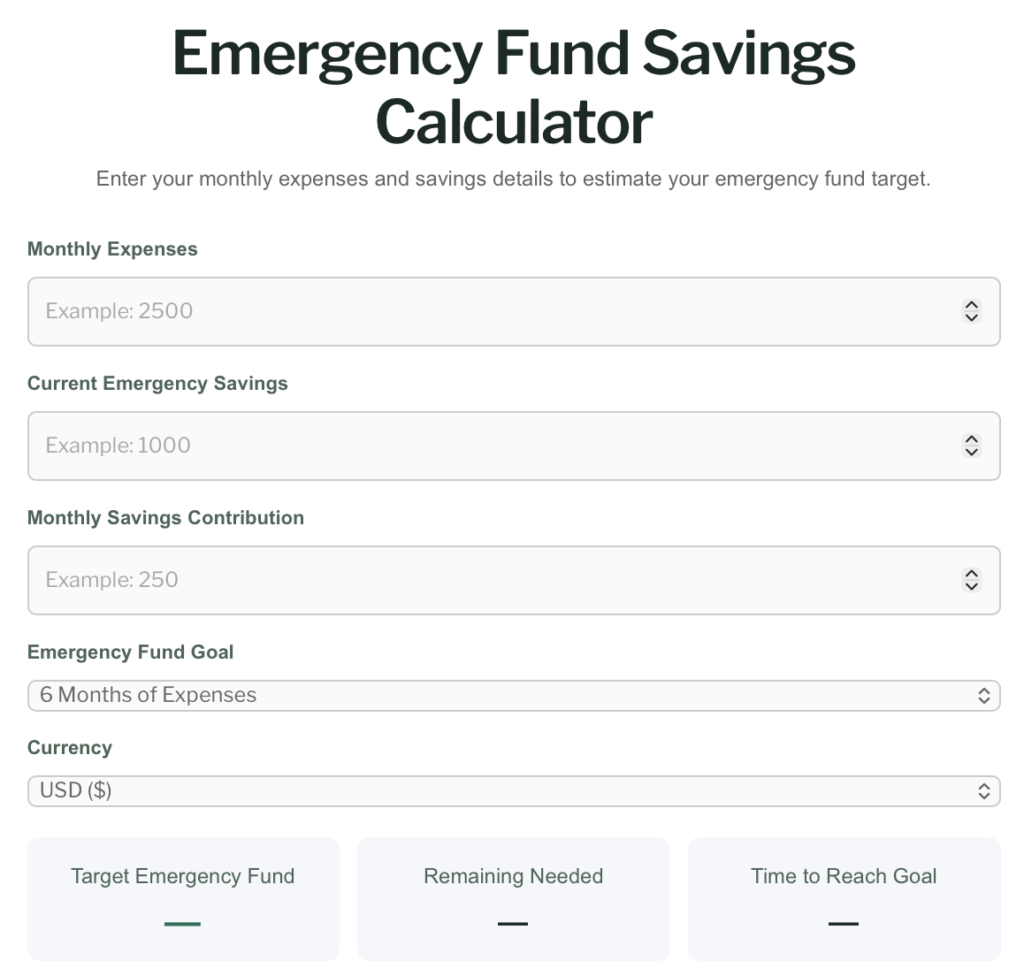
Before guessing how much you should save, it helps to calculate a realistic estimate based on your actual financial situation.
The Money Signals Emergency Fund Calculator helps estimate:
- Essential monthly expenses
- Recommended emergency savings ranges
- Financial coverage timeframes
- Savings targets based on your situation
The calculator is designed to simplify emergency planning by turning vague advice into:
- More realistic estimates
- Personalized planning
- Easier financial visibility
It is especially useful for people who want a clearer understanding of:
- How much emergency savings may realistically help
- How income stability affects savings needs
- How long existing savings could potentially last during financial disruption
Introduction
One reason many people avoid building emergency savings is because the goal feels intimidating immediately.
When people hear:
👉 “You should save several months of expenses”
many immediately think:
- “That sounds impossible.”
- “I could never save that much.”
- “I am already struggling with current bills.”
As a result, some people postpone saving entirely because the target feels:
- Too large
- Too far away
- Emotionally overwhelming
This creates an all-or-nothing mindset:
👉 “If I cannot save the full amount quickly, why even start?”
But emergency savings rarely happen all at once.
Most financial stability is built gradually through:
- Small consistent contributions
- Better financial awareness
- Reduced spending leaks
- Repeated saving habits over time
Another issue is that many emergency fund recommendations lack context.
A generic savings target does not account for:
- Job stability
- Income variability
- Household responsibilities
- Debt obligations
- Medical costs
- Financial flexibility
That is why emergency fund planning works best when it becomes:
👉 Personalized instead of generic.
The purpose of an emergency fund is not creating perfect financial security overnight.
Its purpose is creating:
- Stability
- Flexibility
- Reduced financial panic
- Better resilience during unexpected situations
Even relatively small emergency savings can reduce:
- Dependence on debt
- Financial stress
- Panic-driven decisions
- Long-term financial vulnerability
The goal is not perfection.
The goal is building enough financial breathing room to handle disruptions more safely and more calmly over time.
What an Emergency Fund Is Really For
An emergency fund exists to absorb financial disruption without immediately relying on:
- Credit cards
- Loans
- Borrowing money
- Financial panic
Its purpose is stability—not perfection.
One of the biggest reasons emergency savings matter is income uncertainty.
Examples include:
- Job loss
- Reduced work hours
- Freelance income slowdowns
- Medical leave
- Unexpected employment disruptions
Emergency savings create:
- Time
- Flexibility
- Decision-making space
during financially stressful periods.
Emergency funds are also important for unexpected necessary expenses.
Many emergencies are smaller and more common than people initially expect.
Examples include:
- Car repairs
- Medical expenses
- Appliance replacement
- Utility spikes
- Emergency travel
- Home repairs
Without savings, even moderate unexpected costs can create:
- Debt accumulation
- Overdraft fees
- Delayed bills
- Financial stress
Emergency funds also improve psychological stability.
Many people live with the constant feeling of being:
👉 One unexpected expense away from financial chaos.
Even modest savings can reduce that pressure significantly because financial disruptions become:
- More manageable
- Less emotionally overwhelming
- Less dependent on debt immediately
Emergency funds are not investment accounts designed for aggressive growth.
Emergency savings prioritize:
- Accessibility
- Reliability
- Stability
because the purpose is having money available when genuinely needed.
Why Emergency Fund Advice Often Feels Unrealistic
The common recommendation to save:
👉 “3–6 months of expenses”
exists because it creates a simple financial guideline.
The problem is that simple rules do not always fit complicated real-life financial situations.
Two people with identical incomes may still require very different emergency savings depending on:
- Housing costs
- Debt obligations
- Dependents
- Income stability
- Healthcare needs
- Job risk
For example:
Someone with:
- Stable salaried employment
- Shared household expenses
- Low debt
may require a different emergency savings structure than someone with:
- Freelance income
- Children
- Single-income dependence
- Industry instability
Another issue is psychological.
Large savings goals can create:
- Financial overwhelm
- Procrastination
- Discouragement
especially for people already dealing with:
- Rising living costs
- Debt pressure
- Income instability
That is why emergency savings should be approached as:
👉 A gradual process of increasing financial resilience.
Not:
👉 A perfect number you must reach immediately.
What Affects Your Emergency Fund Target
Emergency savings needs vary because financial risk varies.
One of the biggest factors is:
👉 Income stability.
People with:
- Predictable salaries
- Stable industries
- Consistent work schedules
often face lower short-term income risk than people with:
- Freelance income
- Commission work
- Seasonal employment
- Contract-based work
The more unpredictable income becomes, the more valuable larger savings buffers often are.
Monthly fixed expenses also matter significantly.
Higher obligations increase financial vulnerability during disruptions.
Examples include:
- Rent or mortgage payments
- Insurance
- Loan payments
- Childcare expenses
- Transportation costs
These expenses continue even if income temporarily decreases.
Dependents also affect emergency fund needs.
People supporting:
- Children
- Family members
- Other dependents
usually require more financial flexibility because disruptions affect entire households—not just individuals.
Industry risk matters too.
Some industries experience:
- Frequent layoffs
- Contract instability
- Economic volatility
which may justify maintaining larger emergency reserves.
Ultimately, emergency fund planning is not purely mathematical.
It is also about:
- Risk management
- Stress reduction
- Financial flexibility
- Long-term stability
How to Estimate Your Emergency Fund
Emergency fund calculations are usually simpler than people initially expect.
The goal is estimating:
👉 How much money would realistically help sustain essential expenses during financial disruption.
The first step is calculating your essential monthly expenses.
Focus on:
- Housing
- Utilities
- Groceries
- Insurance
- Transportation
- Minimum debt payments
These categories represent:
👉 Basic survival-level expenses.
Optional lifestyle spending is usually excluded initially.
For example:
- Rent: $1,200
- Utilities: $250
- Groceries: $500
- Insurance: $300
- Transportation: $250
- Minimum debt payments: $300
Estimated essential monthly expenses:
1200+250+500+300+250+300=28001200+250+500+300+250+300=2800
Estimated essentials:
👉 Approximately $2,800 monthly.
Next, choose a target coverage timeframe.
Examples include:
- 3 months
- 6 months
- 9 months
Using the example above:
2800×6=168002800×6=16800
Estimated six-month emergency fund:
👉 Approximately $16,800.
The Money Signals Emergency Fund Calculator simplifies this process by organizing:
- Monthly expenses
- Financial obligations
- Savings estimates
into a more realistic financial planning overview.
The calculator also helps compare different emergency savings scenarios based on:
- Income stability
- Monthly obligations
- Savings goals
Why Small Emergency Funds Still Matter
One major misconception is that small emergency savings are pointless.
That is not true.
Even relatively modest emergency savings can:
- Prevent debt accumulation
- Reduce financial panic
- Improve flexibility
- Interrupt overdraft cycles
- Help absorb smaller emergencies safely
Many people delay saving because they focus only on:
👉 The final target.
But financial resilience improves gradually.
For example:
A starter emergency fund of:
- $500
or - $1,000
may already help cover:
- Minor repairs
- Emergency transportation
- Medical copays
- Temporary financial disruptions
That is why progress matters more than perfection.
Emergency savings are usually built:
👉 Step-by-step over time.
Not all at once.
How to Build an Emergency Fund Gradually
Sustainable emergency savings usually come from:
- Repetition
- Habit-building
- Consistency
rather than aggressive short-term saving attempts.
Even relatively small recurring contributions matter.
For example:
25×4=10025×4=100
Saving approximately:
👉 $25 weekly
creates roughly:
👉 $100 monthly.
Small repeated savings habits compound gradually over time.
Automation can also help significantly.
Automatic transfers reduce:
- Forgetfulness
- Emotional resistance
- Decision fatigue
which improves long-term consistency.
One-time financial opportunities may also accelerate savings growth.
Examples include:
- Tax refunds
- Bonuses
- Cashback rewards
- Side income
It is also important to focus on:
👉 The next milestone
instead of obsessing over the final savings target immediately.
Smaller milestones create:
- Momentum
- Motivation
- Psychological progress
which makes long-term saving feel more achievable.
Where to Keep Your Emergency Fund
Emergency savings should prioritize:
- Accessibility
- Stability
- Reliability
rather than aggressive investment growth.
Many people use:
- High-yield savings accounts
- Separate savings accounts
- Cash management accounts
because these options are generally:
- Easier to access
- Lower risk
- More stable during emergencies
Emergency funds should usually not be stored in:
- Highly volatile investments
- Speculative assets
- Accounts difficult to access quickly
because emergencies often require:
👉 Immediate liquidity.
Keeping emergency savings separate from everyday spending accounts may also reduce:
- Impulse spending
- Accidental withdrawals
- Financial leakage
FAQs About Emergency Funds
Do I really need six months of expenses?
Not necessarily. The right amount depends on your income stability, financial obligations, debt, household responsibilities, and overall risk level.
What counts as a financial emergency?
Unexpected necessary expenses such as medical bills, urgent repairs, temporary income loss, or emergency travel.
Where should emergency savings be stored?
Usually in a safe, accessible savings account rather than high-risk investments.
Can I start with a small emergency fund?
Yes. Even relatively modest emergency savings can improve financial stability and reduce dependence on debt.
How long does it take to build an emergency fund?
That depends on your income, expenses, and savings rate. Most emergency funds are built gradually over time.
The Bottom Line
Emergency fund planning becomes much more useful once it stops being generic.
The right savings target depends on:
- Your expenses
- Your income stability
- Your household responsibilities
- Your debt obligations
- Your financial flexibility
The Money Signals Emergency Fund Calculator helps transform vague financial advice into:
- More personalized planning
- More realistic savings targets
- Better financial visibility
- Stronger long-term financial preparation
The goal is not saving perfectly overnight.
It is building enough financial resilience to handle unexpected situations with:
- Less stress
- More flexibility
- Greater long-term stability
Because even relatively small emergency savings can create meaningful financial breathing room.
Start Here (Simple Action Step)
Take 20–30 minutes this week:
- Calculate your essential monthly expenses
- Open the Money Signals Emergency Fund Calculator
- Estimate a realistic emergency savings target based on your actual financial situation
- Focus on your first savings milestone instead of the final number immediately
- Build consistency gradually over time
👉 Financial resilience is usually built through small repeated improvements—not overnight perfection.
Related Articles
→ How to Build a Small Emergency Fund
Learn how to start emergency savings realistically on a tight budget
→ Realistic Ways to Save $100 This Month
Practical strategies to create extra savings quickly and sustainably
→ How to Save Money Without Feeling Deprived
Build sustainable savings habits without extreme restriction
Simple Insight to Remember
The best emergency fund is not a perfect universal number—it is a realistic financial buffer that helps your household handle unexpected situations with less stress and more stability over time.