
By Money Signals Editorial Team
Money Signals researches debt behavior, repayment psychology, budgeting systems, and financial planning strategies to help readers build more realistic and sustainable approaches to debt reduction. Our goal is to simplify financial concepts into practical systems people can apply consistently in everyday life.
Financial Disclaimer: This article is for informational purposes only and does not constitute financial advice. Debt repayment strategies should always be adjusted based on your personal financial situation, interest rates, income stability, and long-term financial goals.
Who This Guide Is For
This guide is especially useful if you:
- Feel overwhelmed by multiple debts
- Want to understand how long repayment may realistically take
- Are unsure whether your current payments are enough
- Want to compare debt payoff strategies
- Need a clearer repayment structure instead of guessing month-to-month
Debt becomes emotionally exhausting very quickly when there is no clear repayment plan attached to it.
Many people know:
👉 Approximately how much they owe.
But they often do not know:
- How long repayment may realistically take
- How much interest is accumulating
- Whether minimum payments are enough
- Which debts should be prioritized first
Without structure, debt can begin to feel:
- Endless
- Scattered
- Difficult to measure emotionally
Minimum payments reduce balances slowly. Interest continues accumulating quietly in the background. Multiple accounts create confusion about what progress is actually being made.
That uncertainty creates:
- Stress
- Financial fatigue
- Reduced motivation
- A feeling that debt never truly decreases
If you are trying to understand how a debt payoff calculator works, the most important insight is this:
👉 A debt payoff calculator does not magically eliminate debt. It creates visibility, repayment timelines, and decision-making clarity so you can understand what your payments are actually accomplishing over time.
Try the Money Signals Debt Payoff Calculator
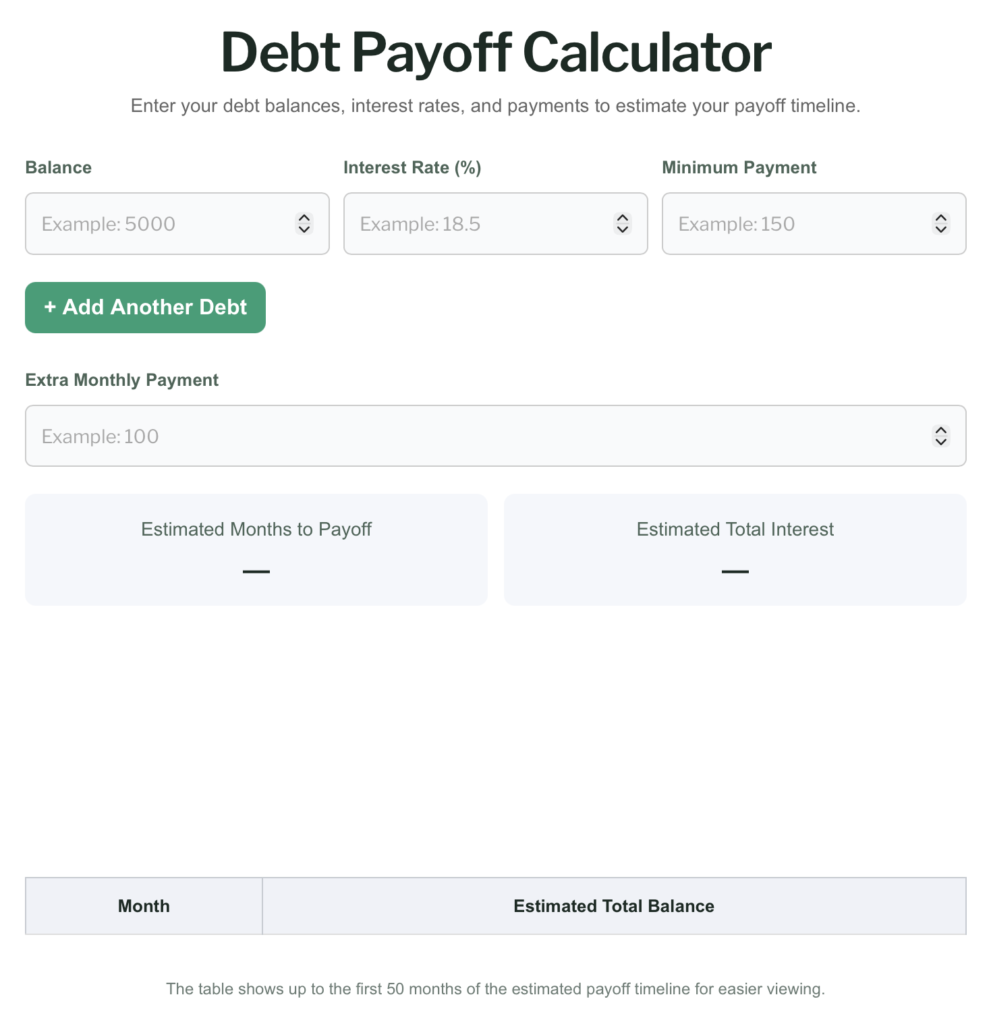
Before building a repayment strategy manually, it helps to organize your debts using a structured tool.
The Money Signals Debt Payoff Calculator helps estimate:
- Debt payoff timelines
- Total interest costs
- Monthly payment impact
- The effect of extra payments
- Different repayment strategy outcomes
The calculator is designed to help transform debt from:
👉 Emotional uncertainty
into
👉 Measurable financial planning.
It is especially useful for:
- Comparing payoff strategies
- Understanding how interest affects repayment
- Estimating how long debt may realistically take to eliminate
- Testing whether extra payments could shorten repayment significantly
Seeing the numbers clearly often reduces financial overwhelm because repayment becomes:
- More structured
- More measurable
- Easier to approach strategically
Introduction
Debt is not only financially stressful.
It also becomes mentally exhausting when progress feels invisible.
Many people continue making payments every month while still feeling like:
- Balances barely move
- Interest never stops accumulating
- The payoff date feels unclear or impossible to estimate
That uncertainty creates frustration because debt begins to feel:
👉 Permanent instead of temporary.
One reason this happens is because multiple balances create confusion.
Debt often involves:
- Credit cards
- Personal loans
- Auto loans
- Medical balances
- Student loans
When several accounts exist simultaneously, it becomes difficult to understand:
- Which debt should be prioritized
- How payments interact
- How long total repayment may realistically take
Interest also makes debt more psychologically difficult because it accumulates gradually in the background.
Even when balances decrease, interest can:
- Slow visible progress
- Increase total repayment cost
- Extend payoff timelines significantly
Many people focus only on:
👉 Minimum monthly payments
without realizing how long minimum-payment repayment structures may actually last.
This creates a major emotional problem:
👉 Lack of a visible timeline.
When people cannot answer:
- “When will this debt realistically be gone?”
repayment begins to feel endless.
That is where debt payoff calculators become valuable.
A calculator helps convert vague repayment into:
- Measurable timelines
- Visible progress estimates
- Clearer decision-making
- More intentional repayment planning
The goal is not finding a “perfect” debt strategy immediately.
The goal is creating enough financial visibility to make repayment feel:
- More manageable
- More structured
- Less emotionally chaotic
over time.
What a Debt Payoff Calculator Actually Shows
A debt payoff calculator organizes debt information into a structured repayment estimate.
Its purpose is helping answer important financial questions such as:
- How long repayment may take
- How much interest may accumulate
- How extra payments affect timelines
- Which repayment strategy may reduce debt faster
One of the most important outputs is:
👉 Estimated payoff timeline.
The calculator estimates how many months or years repayment may require based on:
- Current balances
- Interest rates
- Monthly payment amounts
This helps transform debt from:
👉 Open-ended uncertainty
into
👉 A measurable financial process.
Another important output is:
👉 Total projected interest paid.
Many people underestimate how expensive interest becomes long-term because it accumulates gradually.
A calculator helps reveal:
- How repayment speed affects total borrowing cost
- How interest changes long-term debt outcomes
- Why minimum payments often extend repayment dramatically
The calculator also becomes useful when testing:
👉 Extra payment scenarios.
For example:
An additional:
- $50
or - $100 monthly
may reduce:
- Repayment timelines significantly
- Total interest paid substantially
depending on the debt structure.
The Money Signals Debt Payoff Calculator allows users to compare these repayment scenarios more clearly before making financial decisions.
What You Need Before Using a Debt Payoff Calculator
A debt payoff calculator is only useful if the information entered is reasonably accurate.
Before starting, gather:
- Current debt balances
- Interest rates
- Minimum monthly payments
- Any planned extra payment amounts
Debt balances directly affect:
- Repayment speed
- Interest accumulation
- Timeline estimates
Interest rates are especially important because higher rates generally:
- Increase repayment cost
- Slow progress significantly
You can usually find these details through:
- Loan documents
- Billing statements
- Online account dashboards
Many calculators also allow you to test:
👉 Extra payment amounts.
This helps estimate:
- Potential interest savings
- Timeline reductions
- Repayment acceleration
It is also important to remember that different debt types behave differently.
For example:
- Credit cards often have variable interest rates
- Fixed loans behave more predictably
Understanding these differences helps make calculator projections feel more realistic.
Seeing all debt balances organized together may feel uncomfortable initially.
But visibility is often the first step toward:
- Better planning
- Better prioritization
- Reduced financial confusion
How to Use the Money Signals Debt Payoff Calculator
Using the Money Signals Debt Payoff Calculator is relatively straightforward.
Start by entering:
👉 Each debt separately.
This may include:
- Credit cards
- Personal loans
- Auto loans
- Other outstanding balances
For each account, enter:
- Current balance
- Interest rate
- Minimum monthly payment
This helps create more accurate repayment projections.
Next, test your repayment structure.
You can compare:
- Minimum payments only
- Extra monthly payments
- Different payoff strategies
The calculator then estimates:
- Projected payoff timeline
- Total interest costs
- Long-term repayment impact
This stage is often eye-opening because many people realize:
- Small payment increases can create significant long-term savings.
For example:
100+50=150100+50=150
An extra:
👉 $50 monthly payment increase
may create:
- Faster repayment
- Lower total interest
- Reduced long-term financial pressure
The calculator becomes especially useful when testing multiple repayment scenarios because it helps compare:
- Short-term affordability
- Long-term repayment efficiency
- Overall financial tradeoffs
Understanding Debt Payoff Strategies
Debt payoff calculators become more useful when paired with a clear repayment strategy.
Two common approaches are:
👉 Debt snowball
and
👉 Debt avalanche.
The debt snowball method prioritizes:
👉 Smallest balances first.
Once one balance is eliminated, that payment rolls into the next debt.
People often prefer this strategy because it creates:
- Faster visible progress
- Psychological momentum
- Motivation through smaller wins
The debt avalanche method prioritizes:
👉 Highest interest rates first.
This approach usually:
- Saves more money mathematically
- Reduces long-term interest costs
over time.
The difference is largely:
👉 Psychological versus mathematical optimization.
The snowball method prioritizes:
- Motivation
The avalanche method prioritizes:
- Efficiency
Neither strategy is universally “correct.”
Some people even combine approaches depending on:
- Motivation
- Cash flow
- Stress level
- Financial priorities
The best repayment strategy is usually:
👉 The one you can realistically maintain consistently over time.
How to Interpret Your Results Realistically
The calculator itself is only useful if you understand what the numbers actually represent.
One of the most important benefits is psychological clarity.
Knowing:
👉 A debt may realistically be paid off in three years instead of “someday”
changes how repayment feels emotionally.
The results also reveal:
👉 The value of extra payments.
Even relatively modest increases may reduce:
- Interest costs
- Repayment timelines
- Long-term financial pressure
significantly.
The calculator also helps reveal important tradeoffs.
For example:
- Lower monthly payments may preserve short-term flexibility
while - Extending repayment much longer
This creates a clearer understanding of:
- Cost versus flexibility
- Speed versus affordability
It is also important to focus on:
👉 Patterns and progress
instead of perfection.
Debt repayment is usually:
- A gradual long-term process
not:
- An overnight financial transformation.
Progress may feel slow initially.
That is normal.
The value of the calculator is helping transform emotional uncertainty into:
- Measurable planning
- Visible progress
- Structured decision-making
How to Turn the Results Into a Real Plan
A calculator provides information.
The next step is turning that information into:
👉 Consistent action.
One of the most important steps is choosing:
👉 One clear repayment strategy.
Constantly changing approaches often creates:
- Confusion
- Reduced momentum
- Inconsistent progress
Debt repayment also becomes easier when:
👉 Payments are built intentionally into your budget
instead of handled reactively each month.
Tracking progress visibly also matters psychologically.
Seeing:
- Balances decrease
- Timelines shorten
- Interest savings improve
creates motivation and reinforces consistency.
It is also important to remain flexible.
Income changes. Expenses shift. Emergencies happen.
Debt plans should remain:
- Sustainable
- Adjustable
- Realistic long-term
Aggressive repayment may help mathematically.
But repayment strategies that:
- Destroy quality of life
- Create burnout
- Feel impossible to maintain
often become difficult to sustain consistently.
The long-term goal is not only eliminating balances.
It is creating:
- Stability
- Reduced stress
- Better financial flexibility
- Stronger financial control overall
FAQs About Debt Payoff Calculators
Should I focus on interest or balance first?
That depends on your priorities. Avalanche prioritizes interest savings, while snowball prioritizes psychological momentum and visible wins.
Can I combine repayment strategies?
Yes. Many people adapt repayment methods based on motivation, cash flow, and financial priorities.
What if I cannot afford extra payments right now?
Even organizing debts clearly and understanding your repayment timeline is still extremely valuable.
How accurate are payoff estimates?
They are estimates based on the numbers entered. Actual timelines may change if balances, rates, or payments change over time.
Should I refinance my debt instead?
Refinancing may help in some situations if it lowers interest rates, though it depends on your financial situation and loan terms.
The Bottom Line
Debt feels much more overwhelming when:
- Balances feel scattered
- Interest feels invisible
- Repayment timelines feel unclear
A debt payoff calculator helps organize:
- Balances
- Payments
- Interest costs
- Repayment timelines
into something measurable and easier to understand.
The Money Signals Debt Payoff Calculator helps transform debt repayment from:
👉 Emotional uncertainty
into
👉 More intentional financial planning.
The goal is not perfection.
It is replacing uncertainty with:
- Clarity
- Structure
- Visibility
- Consistent progress
Because once repayment becomes measurable clearly, debt becomes much easier to approach strategically instead of emotionally.
Start Here (Simple Action Step)
Take 20–30 minutes this week:
- Gather your current debt balances and interest rates
- Open the Money Signals Debt Payoff Calculator
- Enter each debt individually
- Compare minimum-payment versus extra-payment scenarios
- Choose one repayment strategy you can realistically maintain consistently
👉 Financial progress often becomes much less overwhelming once the repayment timeline finally becomes visible.
Related Articles
→ How to Lower Recurring Bills Without Changing Everything
Reduce monthly expenses to free up more debt repayment money
→ How to Estimate Your Emergency Fund (Simple Guide)
Balance debt repayment with financial safety planning
→ How to Find Where Your Money Is Disappearing
Identify spending leaks that may be slowing debt progress
Simple Insight to Remember
A debt payoff calculator does not eliminate debt automatically—it helps transform repayment from emotional uncertainty into a clearer, more measurable financial plan.