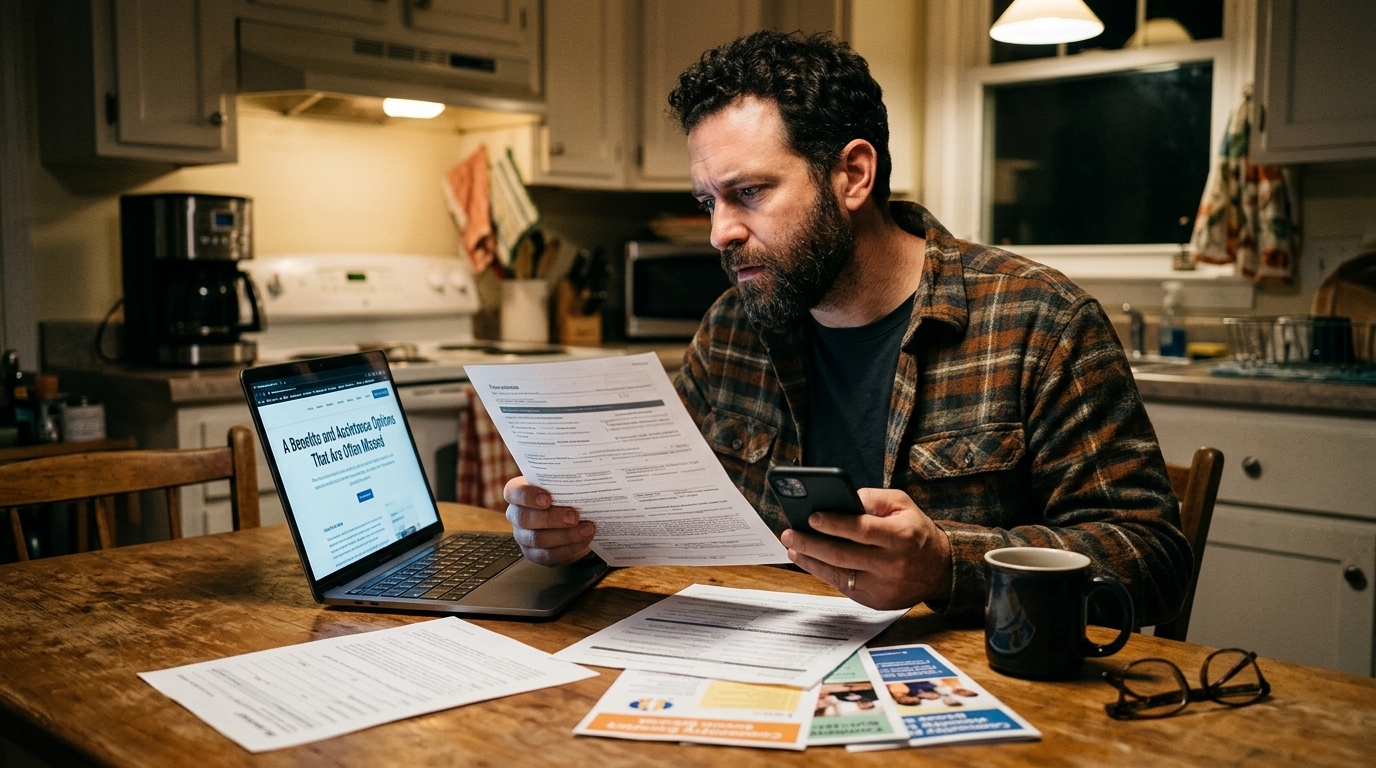
Most people search for help once, find a few familiar program names, decide they don’t qualify or can’t navigate the process, and stop. That single search almost always misses the most useful layer of available support.
The programs everyone already knows — SNAP, Medicaid, Section 8 — are real and valuable. But they’re also the most heavily searched, most frequently waitlisted, and most commonly associated with the ‘I already checked that’ response. Meanwhile, a parallel set of assistance options sits in categories most people never think to look at: workplace benefits they’re entitled to but haven’t claimed, tax credits that arrive as refunds even for people who owe nothing, seasonal energy programs with better odds of approval, caregiver support described in language that doesn’t sound like money, and local emergency funds that open and close unpredictably and only show up if you call 211.
This guide is specifically about that second layer. Every program and category here is legitimate, official, and genuinely underused. None of it is vague. All of it has a verifiable government or recognized nonprofit source behind it. The goal is to give you a practical map of what tends to stay invisible — and exactly where to find it.
|
📋 REAL SCENARIO: The Colleague Who Found Four Programs Nobody Knew About At a community resource fair in St. Louis, a financial counselor described four programs she had helped clients access that month — all programs the clients had never heard of: WAP (home weatherization that reduced one family’s energy bills by $440/year permanently), the EITC (a $2,800 refund for a part-time worker who had filed but not claimed the credit), an employer-sponsored dependent care FSA a warehouse worker had never enrolled in ($2,500 in pre-tax childcare savings), and VA Respite Care for a veteran’s caregiver who had been burning out for two years. All four were real. All four were being missed daily. |
In this article, you will discover:
- Why Legitimate Help Stays Invisible
- Lesser-known federal and state benefit programs
- Community and nonprofit assistance often overlooked
- Employer and workplace benefits many people don’t claim
- Seasonal and temporary assistance programs worth knowing
- How to regularly check for benefits you might have missed
- FAQs about overlooked benefits and assistance options
Why Legitimate Help Stays Invisible
Understanding the specific patterns behind missed benefits makes them easier to catch. There are four distinct mechanisms at work.
Pattern 1: It Doesn’t Sound Like Financial Help
‘Weatherization Assistance’ sounds like a home improvement program. ‘Housing Counseling’ sounds like advice. ‘Dependent Care Assistance Program’ sounds like HR paperwork. ‘Respite Care’ sounds like a medical service. None of these phrases trigger the mental association with ‘financial help’ — which is precisely why they go unclaimed. A household receiving weatherization services is getting work worth several thousand dollars at no cost, with permanent bill reductions lasting the life of the home. The framing doesn’t match the value.
Pattern 2: It Only Becomes Relevant After a Life Event
Many assistance options are triggered by specific circumstances: a disability, a disaster declaration, a new caregiver role, a job loss, a new child, a move, a heating season with extreme temperatures. People who checked benefits a year ago and found nothing relevant may find several relevant options today because their circumstances changed. A one-time search is only accurate for the moment it was run.
Pattern 3: It Lives Only at the Local Level
Emergency rental funds, county utility programs, local food banks with no eligibility requirements, caregiver support organizations, and community legal aid offices often don’t exist in any federal database. They’re administered by nonprofits and county agencies that don’t invest in web visibility. The only reliable way to reach this layer is through 211 — a system specifically designed to catalog what’s available locally in real time.
Pattern 4: It Requires Action at an Unlikely Time
The EITC is most valuable during tax filing season — and many people who qualify don’t claim it because they don’t know it’s refundable. LIHEAP is most valuable in fall before heating bills arrive — but people apply in winter when funds may be depleted. Disaster assistance requires action within a specific window after a declaration. Timing determines whether help is available, and most people only search when pressure is already acute.
|
🔎 KEY INSIGHT: The One-Time Search Problem Benefits change. Circumstances change. Program enrollment windows open and close. Local funds come and go. A search that found nothing six months ago may find three relevant programs today. The households that get the most from available assistance search again after any significant life change, at the start of each season, and once per tax year — not just once when the pressure first arrives. |
Lesser-Known Federal and State Benefit Programs
These programs are official, federally funded, and consistently underused — not because they’re hard to access, but because they fall outside the usual search radius.
Weatherization Assistance Program (WAP) — Permanent Bill Reduction, Not a One-Time Credit
Most people searching for utility help look for programs that pay a bill. WAP does something more durable: it physically improves a home’s energy efficiency at no cost, permanently reducing how much energy the household needs and therefore how much they pay every month going forward.
The work varies by home but commonly includes attic and wall insulation, air sealing around windows and doors, heating and cooling system tune-ups or replacements, and water heater upgrades. The Department of Energy estimates average annual energy savings of $372 or more per household — and in older, poorly insulated homes, savings are often significantly higher. The improvements last for the life of the home. The household pays nothing.
WAP is administered by state and local agencies — typically the same community action agencies that handle LIHEAP. Income eligibility is generally at or below 200% of the federal poverty level. Critically, households that receive SSI or TANF may qualify automatically through categorical eligibility, bypassing the standard income documentation process.
|
📋 REAL SCENARIO: WAP: The Program That Keeps Paying Every Year Dorothy, 71, in rural West Virginia lived in a drafty house built in 1962. Her heating bills ran $220–$280/month in winter. Her county community action agency applied her for WAP. The assessment found inadequate attic insulation, a cracked furnace heat exchanger, and significant air leakage around windows. Repairs took three days. Her heating bills dropped to $130–$160/month the following winter. Annual savings: approximately $720. The work cost her nothing. She had qualified for years without knowing WAP existed. |
Who qualifies: Income at or below 200% FPL; SSI and TANF recipients often qualify automatically
Where to apply: Search ‘[your state] weatherization assistance program’ for the local administering agency
Key fact: WAP and LIHEAP are often administered by the same office — ask about both in one call
LIHEAP — The Program People Find Too Late
LIHEAP (Low Income Home Energy Assistance Program) is relatively well known, but it’s almost universally applied for at the wrong time. Most people contact LIHEAP agencies in the middle of winter when their heating bill is overdue and a shutoff notice has arrived. By that point, many state allocations are severely depleted.
LIHEAP operates on a first-come, first-served basis in most states. Funds are capped and don’t automatically replenish. In cold-weather states, enrollment typically opens in September or October for heating assistance. A household that applies in October is competing with far fewer applicants than one that applies in January. The program doesn’t change — but the odds do.
LIHEAP also covers cooling assistance in many states (for summer air conditioning costs), and some states have a separate crisis component for shutoff prevention at any time of year. These sub-programs are even less well known than LIHEAP itself.
Benefit range: Varies widely by state; cold-weather states may offer $400–$1,500 per season
Best timing: Apply at the start of enrollment — typically fall for heating, spring for cooling
Emergency use: Call 211 immediately for shutoff risk — local emergency funds often move faster
Where to apply: Search ‘[your state] LIHEAP office’ — application goes through a local agency, not federal
CHIP — The Children’s Coverage Gap Most Parents Don’t Realize Exists
CHIP (Children’s Health Insurance Program) exists for one specific gap: families who earn too much for their children to qualify for Medicaid, but not enough to comfortably afford private insurance. It’s comprehensive — doctor visits, immunizations, dental, vision, prescriptions, emergency care, mental health services — and most states charge little or no premium with minimal copays.
The income band CHIP covers is wider than most parents expect. In many states, children in families earning up to 200–300% of the federal poverty level qualify. For a family of four, that can extend to household incomes in the $60,000–$80,000 range depending on the state. Parents who checked Medicaid, found their children didn’t qualify, and stopped never learned that CHIP exists as a separate program filling exactly that gap.
CHIP enrollment is open year-round. There’s no enrollment window to wait for.
|
📋 REAL SCENARIO: CHIP: Three Years of Unnecessary Premiums Kevin and Angela in Georgia had been paying $380/month to cover their two children on a Marketplace plan since their kids didn’t qualify for Medicaid. A benefits counselor at their pediatrician’s office asked about their income. They earned $71,000 combined. Georgia’s CHIP threshold for two children was $76,000. Both kids enrolled in CHIP at no premium. Annual savings: $4,560. They had been eligible since their youngest was born. |
Income range: Typically 138%–300% of FPL depending on state — check your state’s specific threshold
Enrollment: Open year-round — no waiting for an enrollment period
Where to apply: medicaid.gov/chip or search ‘[your state] CHIP enrollment’
VA Respite Care and Caregiver Support — Help That Doesn’t Sound Like Money
Caregiver assistance is one of the most consistently missed categories in the benefits landscape — primarily because nobody searching for financial help thinks to search for ‘caregiver support.’
The VA’s Caregiver Support Program includes the Program of Comprehensive Assistance for Family Caregivers (PCAFC), which can provide a monthly stipend paid directly to the caregiver, access to health insurance if the caregiver isn’t otherwise covered, mental health counseling, and respite care services. For caregivers who have reduced or eliminated paid work to care for a veteran, PCAFC stipends can represent hundreds of dollars per month in direct compensation — plus coverage they may not have had.
VA Respite Care specifically gives caregivers temporary relief through in-home respite, adult day care, or short-term inpatient care for the veteran. For households where a family member has been providing unpaid full-time care, these programs can represent over $10,000 in annual combined value that most caregivers never apply for.
|
📋 REAL SCENARIO: Caregiver Stipend: The Money Nobody Mentioned Rosa, 52, had been caring full-time for her husband, a veteran with a service-connected TBI, for four years. She had stopped working and was managing on his VA disability pay. A VA social worker at his annual appointment mentioned PCAFC. She applied. After approval, she received a monthly caregiver stipend of $840, access to CHAMPVA health coverage, and 30 days per year of respite services. Total annual value: over $13,000. She had been eligible since her husband’s condition was first documented. |
Main programs: PCAFC (stipend + health coverage + respite) and General Caregiver Support Services
Who qualifies: Caregivers of eligible veterans with serious injuries — eligibility rules apply
Where to apply: caregiver.va.gov or contact your VA medical center’s Caregiver Support Coordinator
Disability Housing Grants for Veterans — Not Just Rent Vouchers
When most people think of housing assistance for veterans, they think of HUD-VASH vouchers or Section 8. But there’s an entirely separate category of housing help for veterans with certain service-connected disabilities: grants to purchase or modify a home to accommodate their needs.
The Specially Adapted Housing (SAH) grant and the Special Housing Adaptation (SHA) grant help eligible veterans with qualifying service-connected disabilities build, buy, or modify a home to meet their accessibility and functional needs. SAH grants can exceed $100,000; SHA grants can exceed $20,000. These are grants — not loans — specifically for veterans whose disabilities affect their ability to live independently in a standard home.
This program gets missed because it only surfaces in searches specifically about veteran disability housing — not in general housing or disability searches. Veterans with mobility impairments, loss of limbs, blindness, or severe burns may qualify without knowing these grants exist.
Grant amounts: SAH: up to $109,000+ (adjusted annually); SHA: up to $21,900+ (adjusted annually)
Who qualifies: Veterans with specific service-connected disabilities — VA determines eligibility
Where to apply: va.gov/housing-assistance/adaptive-housing-grants or call 1-800-827-1000
BenefitsCheckUp — The Senior-Specific Screener Most Households Haven’t Heard Of
General benefit screeners like Benefits.gov and USAGov are useful for broad coverage. But for adults 55 and older, BenefitsCheckUp — operated by the National Council on Aging — is significantly more comprehensive. It screens for over 2,500 federal, state, and local programs specifically relevant to older adults, including many that never appear in general searches.
Programs it surfaces include Medicare Savings Programs, Extra Help for prescription costs, state pharmaceutical assistance, property tax relief, home repair assistance, senior transportation subsidies, legal aid, and caregiver support — in addition to standard federal programs. The breadth of state and local coverage is what makes it different from general tools.
For any household with adults 55 and older, running BenefitsCheckUp alongside Benefits.gov takes about 15 minutes and consistently surfaces programs the general tools miss. It’s free, requires no account, and is entirely confidential.
Who it’s for: Adults 55+ and households including seniors
Where to find: benefitscheckup.org — free, no account required, confidential
Key advantage: Screens 2,500+ programs including state and local options not in federal databases
Community and Nonprofit Assistance Often Overlooked
211 — The Local Layer That No Federal Database Reaches
211 is not a single program. It’s the system that makes local assistance findable. Operated by United Way and local affiliates, 211 maintains real-time databases of available assistance in each area — food banks, emergency rental funds, utility assistance, childcare referrals, mental health services, transportation, caregiver support, disaster recovery, and more.
The critical difference between 211 and federal benefit databases: 211 knows what’s open right now. Emergency rental funds open and close based on available funding. Local food banks have current hours. County utility programs have current waitlist status. Federal databases reflect what programs exist. 211 reflects what’s currently accepting applicants in your specific area.
211 is also the right starting point for complex situations. If someone explains their full picture — behind on rent, utilities at risk, children in the household, thinks they earn too much for most programs — a 211 specialist can navigate across multiple categories at once and connect them to organizations with more flexibility than federal programs. That conversation is exactly what 211 is designed for.
|
💡 PRO TIP: How to Use 211 Effectively Don’t just search 211.org and browse categories. Call 211 or text your ZIP code to 898-211 and talk to a specialist. Specialists have real-time information about what’s currently open, who’s accepting applications without a waitlist, and which local organizations have discretionary funds for situations outside standard program eligibility. A 10-minute call surfaces more than an hour of web searching for local options. |
How to reach: Call or text 211; text ZIP to 898-211; or search 211.org by location and category
Best for: Urgent needs, local emergency funds, situations spanning multiple categories at once
Available: Free, confidential, 24/7 in most areas
HUD-Approved Housing Counseling — Free Expert Help Almost Nobody Calls
HUD maintains a nationwide network of certified housing counseling agencies providing free or very low-cost help with renting, buying, mortgage default, foreclosure prevention, and housing stability. These aren’t general advice lines — they’re trained counselors who navigate specific housing situations, know local programs, and can intervene in ways most people don’t know are possible.
What housing counselors actually do: they review lease agreements for problems, help renters respond to eviction notices, explain legal rights, negotiate payment plans with landlords or mortgage servicers, connect people to local emergency rental funds, and identify housing programs the household qualifies for that they haven’t yet applied for. HUD provides foreclosure prevention and homelessness counseling free of charge.
|
📋 REAL SCENARIO: Housing Counselor: One Appointment, Three Outcomes Priscilla, 44, in Baltimore was 60 days behind on rent and had received a pay-or-quit notice. She found a HUD-approved counselor through hud.gov/counseling. In one session, the counselor identified that her landlord’s notice didn’t comply with local requirements (buying time), connected her to an emergency rental fund covering $1,800 in back rent, and helped her apply for SNAP and LIHEAP simultaneously. The legal issue she didn’t know she had, the fund she didn’t know existed, and two benefit applications she hadn’t started — all addressed in a single free appointment. |
Cost: Free or very low cost — HUD-approved agencies cannot charge excessive fees
Where to find: hud.gov/counseling — search by ZIP code for local certified agencies
Best for: Eviction risk, foreclosure, lease disputes, housing program navigation
Area Agencies on Aging — The Senior Support Network Almost Nobody Knows Exists
Every region in the United States has a federally funded Area Agency on Aging (AAA) that coordinates local services for older adults and their caregivers. These agencies coordinate home-delivered and congregate meals, transportation to medical appointments, in-home assistance, caregiver support, legal aid, health insurance counseling, benefits enrollment assistance, and connections to local emergency funds.
Many of these services are available to adults 60 and older regardless of income — they aren’t means-tested the way most federal programs are. For caregivers of older adults, AAAs also coordinate the National Family Caregiver Support Program, providing counseling, respite care, education, and supplemental services.
Who it serves: Adults 60+ and their caregivers; some services available to younger adults with disabilities
Where to find: Search ‘Area Agency on Aging [your county]’ or call Eldercare Locator: 1-800-677-1116
Key advantage: Coordinates local services that don’t appear in any federal database
Employer and Workplace Benefits Many People Don't Claim
Not all assistance comes through public benefit systems. For employed people, some of the most valuable financial relief comes through workplace benefits that employees are entitled to but rarely review carefully.
Dependent Care Flexible Spending Accounts — Pre-Tax Childcare Savings Left on the Table
A dependent care FSA is an employer-sponsored benefit that allows employees to set aside pre-tax dollars — up to $5,000 per year for most households — to pay for qualifying childcare or adult dependent care expenses. Because contributions come out before income and payroll taxes are applied, the effective savings is typically 20–35% of whatever amount is contributed.
For a worker contributing the maximum $5,000 in a 22% federal tax bracket, the tax savings alone is approximately $1,100 — plus payroll tax savings. The money is used for the same childcare costs the household is already paying. The only difference is that a portion of it is paid with pre-tax income. No additional spending required.
Dependent care FSAs are offered by many employers but are frequently unused because employees don’t review benefits during open enrollment or don’t realize the FSA doesn’t require any additional spending. Workers with children under 13, or with adult dependents requiring care, should check with HR every open enrollment period.
Annual limit: $5,000/year for most households ($2,500 if married filing separately)
Typical savings: $1,000–$1,750/year depending on contribution and tax bracket
Where to enroll: Through your employer’s open enrollment — ask HR specifically about dependent care FSA
Important note: Use-it-or-lose-it rules apply — only contribute what you will spend within the plan year
Employer Educational Assistance — Up to $5,250/Year in Tax-Free Tuition Help
Under IRS rules, employers can provide up to $5,250 per year in educational assistance to employees on a tax-free basis. Qualifying expenses include tuition, fees, books, supplies, and equipment for undergraduate or graduate courses. The employee pays no income tax on this benefit. Both sides benefit — and surveys consistently show that a significant share of workers at companies offering this benefit never use it.
For a worker considering a certification program, community college courses, or a degree that could advance their career, this benefit can represent thousands of dollars in annual support without any government application, income verification, or waitlist.
|
💡 PRO TIP: Ask HR These Two Questions at Open Enrollment (1) Does our company offer a dependent care FSA, and what is the enrollment deadline? (2) Do we have an educational assistance program, and what courses are covered? Many employees assume these benefits don’t apply to them when they do. A five-minute conversation during open enrollment can surface thousands of dollars in annual savings. |
Annual limit: $5,250/year tax-free under IRS rules
What it covers: Tuition, fees, books, supplies, equipment for undergraduate and graduate courses
Where to find: Your employer’s HR department or benefits handbook
Health FSAs and Health Savings Accounts — Pre-Tax Medical Expense Savings
Health FSAs and HSAs allow employees to pay for qualifying medical, dental, and vision expenses with pre-tax dollars — effectively reducing the real cost of every eligible expense by the employee’s marginal tax rate. An employee in the 22% bracket who spends $2,000 on out-of-pocket medical costs saves approximately $440 by paying through an FSA or HSA rather than from after-tax income.
HSAs are available only to people enrolled in high-deductible health plans and have a key advantage: unused balances roll over indefinitely and can be invested. FSAs are use-it-or-lose-it within the plan year but available with a wider range of health plans. Both are consistently underused by employees who are eligible but never open or maximize them.
HSA limits (2024): Up to $4,150 individual / $8,300 family; rolls over indefinitely
FSA limit (2024): Up to $3,200; typically use-it-or-lose-it within the plan year
Where to enroll: Through your employer’s open enrollment or health plan administrator
Seasonal and Temporary Assistance Programs Worth Knowing
Some of the most valuable assistance options are tied to specific times of year, specific life events, or specific emergency declarations. People who search once and stop miss these entirely.
The Earned Income Tax Credit — Thousands Unclaimed Every Filing Season
The Earned Income Tax Credit (EITC) is a refundable federal tax credit for workers with low to moderate income — meaning eligible filers can receive it as a cash refund even if they owe no taxes. It’s one of the largest anti-poverty programs in the U.S. by dollar value, and the IRS estimates roughly 20% of eligible workers fail to claim it every year.
The credit amount varies based on income, filing status, and qualifying children. For the 2023 tax year, the maximum credit was $7,430 for a family with three or more qualifying children. Even workers with no children can qualify for a smaller credit. It’s claimed on a standard federal tax return — no separate application, no government office visit, no waitlist.
Why it gets missed: some workers assume they earn too much. Others use simple filing tools and don’t review all applicable credits. Self-employed workers sometimes don’t realize net self-employment income qualifies. The IRS provides a free EITC Assistant at irs.gov/eitcassistant that takes five minutes and returns a definitive answer.
|
📋 REAL SCENARIO: EITC: The Refund That Never Got Claimed Marcus, 34, drove for a rideshare company part-time and worked a part-time retail job, earning about $24,000 combined. He filed his taxes with a free tool each year and received a small refund. A tax clinic volunteer reviewed his return and found he had never claimed the EITC. For his income and household, the credit was $2,971. He amended two prior years’ returns and received nearly $6,000 in combined refunds he had earned and never collected. |
Max credit (2023): $7,430 for 3+ qualifying children; $600+ for workers with no children
How to check: irs.gov/eitcassistant — free, takes about 5 minutes
Can amend: Prior-year returns can be amended up to 3 years back to claim missed EITC
Other Tax Credits Often Left Unclaimed
The EITC is the most commonly overlooked tax credit, but several others are routinely unclaimed by people who qualify. The Child Tax Credit provides up to $2,000 per qualifying child under 17, with up to $1,600 refundable for households with little or no tax liability. The Child and Dependent Care Credit offsets a percentage of qualifying care expenses — separate from any employer FSA benefit. The Premium Tax Credit helps Marketplace health insurance buyers with premiums based on income and household size. The American Opportunity and Lifetime Learning Credits offset higher education expenses.
Each requires active claiming on a tax return. None arrive automatically. The IRS Free File program at irs.gov/freefile provides free federal return preparation for qualifying households through partner software that typically identifies applicable credits as part of the guided process.
Child Tax Credit: Up to $2,000/child under 17; up to $1,600 refundable per child
Child/Dependent Care: 20–35% of qualifying care expenses up to $3,000 for one dependent
Free filing: irs.gov/freefile — free federal return preparation for qualifying households
Disaster Food Relief and FEMA Assistance — Event-Based Help With a Short Window
Two forms of disaster-related assistance are consistently missed because they’re time-limited and event-specific: D-SNAP and FEMA Individual Assistance.
D-SNAP provides short-term food benefits to households in presidentially declared disaster areas who don’t normally receive SNAP. Eligibility is broader and faster to process than standard SNAP, and benefits can be issued within days of a declaration. The application window is typically two weeks or less.
FEMA’s Individuals and Households Program provides financial assistance and direct services to people affected by a disaster — including temporary housing help, home repair, rental assistance, and medical or dental expenses caused by the disaster. Applications must typically be filed within 60 days of the declaration. The most common mistake: assuming insurance disqualifies you. Insurance and FEMA assistance aren’t mutually exclusive — FEMA may cover unmet needs that insurance doesn’t fully address.
|
⚠️ WATCH OUT: Disaster Assistance Has Short Windows Both D-SNAP and FEMA IHP have application deadlines typically running 2–8 weeks after a disaster declaration. Missing the window means missing the benefit — there are generally no extensions. If you’re in a declared disaster area, check disasterassistance.gov and your local 211 immediately, even if you’re unsure you qualify. Having insurance does not automatically disqualify you. The check takes minutes; the deadline doesn’t wait. |
D-SNAP: Check benefits.gov after any disaster declaration in your area
FEMA assistance: disasterassistance.gov — apply within the posted deadline (typically 60 days)
How to Regularly Check for Benefits You Might Have Missed
The households that capture the most available help are not the ones who searched hardest once. They’re the ones who search again when circumstances change, when seasons shift, and when a new life event opens a different set of options.
Once a Year — At Tax Time
Run through the EITC Assistant, check all applicable credits, and use Free File if eligible. Review your employer benefits for the upcoming plan year, specifically checking for dependent care FSA, educational assistance, and HSA or FSA enrollment. If your income changed significantly, re-run Benefits.gov or USAGov Benefit Finder — income changes affect eligibility across multiple programs.
At the Start of Each Major Season
Fall is the most important season for energy-related benefits. LIHEAP enrollment opens in most states in September or October. WAP assessments can be scheduled year-round but are often prioritized before heating season. If you have income-qualifying neighbors or family members, this is also the right time to mention both programs — they require advance action to get ahead of the enrollment curve.
After Any Significant Life Event
Job loss, a new child, a move to a new state, a new disability, a new caregiving responsibility, a marriage, a divorce, a significant income change, or a disaster in your area — any of these can open eligibility for programs that didn’t previously apply. Run a full benefits screen after any major life change, and call 211 for local resources that may not surface in federal tools.
After a Denial
A denial from one program in a category doesn’t close the category. Check adjacent programs. Verify that you used net income after applicable deductions, not just gross. Ask the administering office what would need to change for you to qualify. For disability programs specifically, a denial is frequently the beginning of a process rather than a final answer — SSDI appeal success rates are substantial.
|
💡 PRO TIP: The Annual Benefits Audit — Under 30 Minutes Once a year, run this sequence: (1) Check irs.gov/eitcassistant for EITC eligibility. (2) Run Benefits.gov Benefit Finder for your current household situation. (3) If adults 55+ are in the household, also run benefitscheckup.org. (4) Call 211 and ask what has changed locally since last year. (5) Review employer open enrollment for dependent care FSA and education benefits. Under 30 minutes once a year surfaces most of what’s being missed. |
FAQs About Overlooked Benefits and Assistance Options
Do I have to be in financial crisis to qualify for most of these?
No — and that assumption is one of the main reasons these programs get missed. WAP doesn’t require an overdue energy bill. CHIP doesn’t require your child to be uninsured due to job loss. The EITC requires qualifying income and a filed return, not hardship. Employer benefits require no financial need at all. Many of the most valuable options on this list are available to working households at moderate income levels who simply haven’t claimed what they’re entitled to.
What if I don’t work for an employer that offers these benefits?
Employer benefits only apply to employed workers with those specific benefits available. Self-employed and gig workers should focus on the public benefit and tax credit categories instead. The EITC specifically includes self-employment income in its qualifying income calculation. The Premium Tax Credit through the Marketplace provides similar relief on health insurance costs for people without employer coverage.
What’s the fastest way to find local help I haven’t tried yet?
Call 211. It takes 10 minutes, is free and confidential, and connects you to a live specialist with real-time information about what’s open and accepting applications in your specific area. No other tool — federal screener, state portal, or web search — gives you the same combination of local specificity and current availability. For the local layer, 211 is irreplaceable.
How do I know which of these applies to my situation?
Start with the category causing the most financial pressure right now. Energy bills point to LIHEAP and WAP. Children’s health coverage points to CHIP. Childcare costs point to the dependent care FSA and Head Start. Tax season points to the EITC. Not sure where to start: run Benefits.gov Benefit Finder and call 211. Between the two, you’ll surface most of what applies.
Are any of these available if I’ve received benefits before?
Yes — prior receipt of a different program generally doesn’t affect eligibility for the programs listed here. Programs are independent of each other. The only caveat is that some programs have their own recertification cycles, and households previously enrolled whose benefits were discontinued should check current eligibility against updated circumstances.
The Bottom Line
The programs and benefits on this list are not obscure or experimental. They’re funded, operational, and available right now. What makes them ‘often missed’ isn’t that they’re hidden — it’s that they sit outside the small set of program names most people already know, described in language that doesn’t immediately signal financial help, or triggered by specific circumstances most people haven’t thought to check for.
The corrective is simple: search in categories, not just program names. Search again after life changes. Check your workplace benefits every open enrollment. Run the EITC assistant every tax season. Call 211 once a year to see what’s changed locally. Check BenefitsCheckUp if your household includes adults over 55.
None of these steps requires significant time. Together, they cover most of what goes unclaimed by households who did one search and stopped.
Pick one category from this guide that you haven’t checked. That is the whole next step.
Related Articles
If you want to learn more about financial support and financial benefits, check out these articles:
- Where to Find Verified Financial Support Programs Safely
Best next step if you want to verify that the programs and sources you find are legitimate before you share personal information. - How to Check for Available Benefits Without Guesswork
Best if you want a cleaner repeatable process for checking categories, local options, and next steps without confusion. - Financial Benefits People Overlook in the U.S.
Best if you want to go deeper into overlooked mainstream benefits and official U.S. directories that many people miss the first time around.