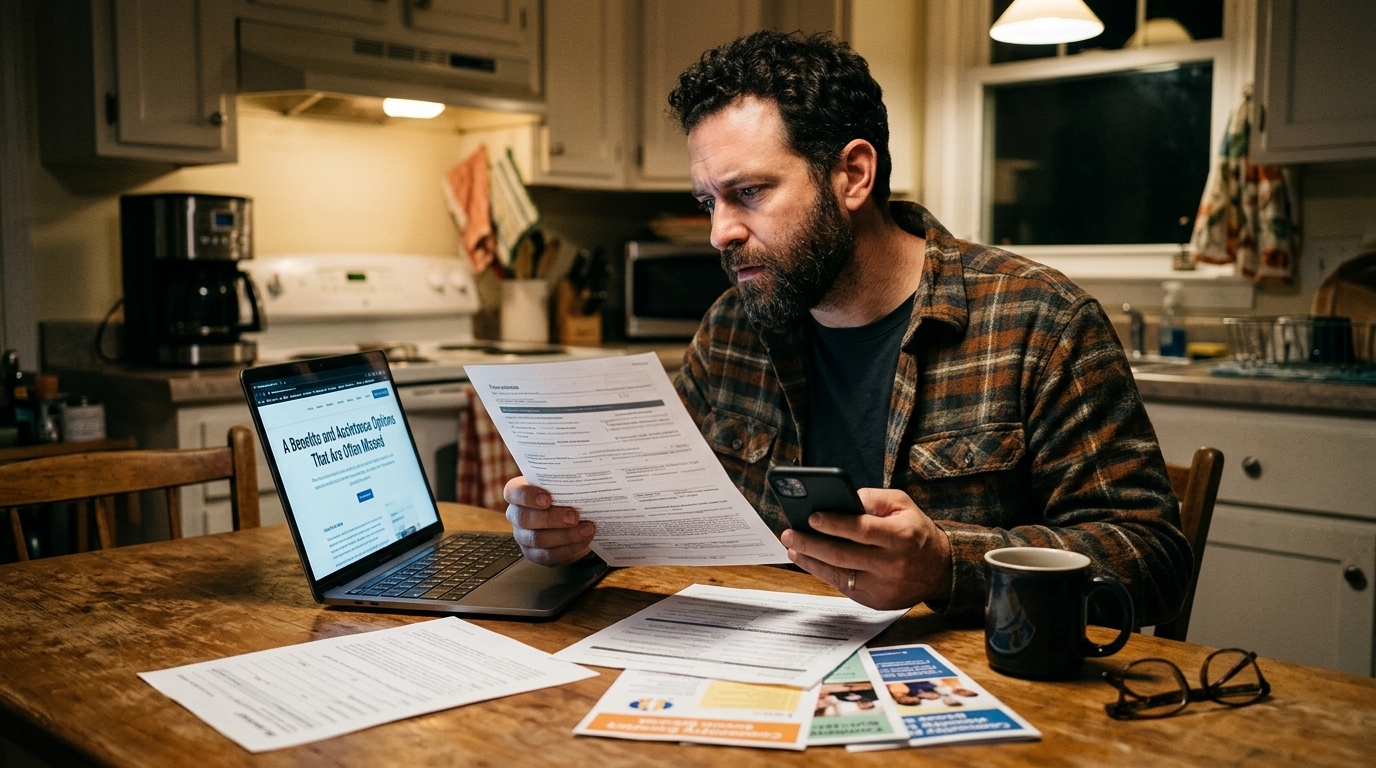
Most people assume financial benefits are for someone else. Someone earning less. Someone in more obvious hardship. Someone whose situation is more clearly defined as need. That assumption is one of the most common reasons support goes unclaimed — not because the programs are rare, but because the people who qualify for them never look.
The U.S. government and a network of state, local, and nonprofit organizations administer hundreds of assistance programs covering food, housing, utilities, healthcare, childcare, job training, disability support, and more. Many of these programs have income thresholds that extend into moderate-income ranges. Many have eligibility criteria beyond income — age, household size, caregiving responsibilities, a recent life change, a medical condition, a geographic location. And many are currently operating below capacity because eligible households have not applied.
Now is a reasonable moment to check. Eligibility thresholds are updated annually. New programs are introduced. State budgets shift. And your own circumstances — income, household composition, housing costs, employment status — may have changed since the last time you looked or assumed there was nothing to look for.
This guide walks through what’s available, who it actually applies to, and how to approach the review process in a way that is practical, specific, and grounded in real situations rather than vague generalities.
TABLE OF CONTENTS
- Why It’s Worth Reviewing Your Financial Benefits This Year
- The Types of Financial Benefits You Should Check
- Who Typically Qualifies — and Why the Answer Often Surprises People
- How to Start Checking What You May Be Eligible For
- Common Mistakes That Stop People Before They Start
- What to Do After You Find a Benefit You May Qualify For
- Frequently Asked Questions About Financial Benefits
Why It's Worth Reviewing Your Financial Benefits This Year
The most common reason people skip a benefits review is the belief that it won’t apply to them. That belief is often formed quickly, without checking, and based on broad assumptions rather than actual eligibility criteria. What research on benefits enrollment consistently shows is that the gap between who qualifies for programs and who uses them is significant — and the gap is explained not by a lack of eligibility but by a lack of inquiry.
Eligibility criteria change every year
Many federal and state benefit programs adjust income thresholds, asset limits, and qualifying criteria annually. A household that didn’t qualify for the Supplemental Nutrition Assistance Program (SNAP) in the previous year might qualify this year if the household’s income has changed, if their state has expanded eligibility, or if the federal poverty guidelines — to which many program thresholds are tied — have shifted. Checking once and not checking again is not a review strategy; it is simply the absence of one.
Life changes open new eligibility windows
Several specific life events commonly shift a household from non-eligible to eligible for programs they had previously not considered. These include:
- A reduction in work hours or a job transition that lowers annual income
- The birth or adoption of a child, or gaining custody of a dependent
- A rent increase that raises housing costs above 30% of household income
- A new medical diagnosis or the development of a qualifying disability
- A household member reaching 60 or 65 and entering senior-benefit eligibility
- Moving to a new state with different program structures or higher benefit thresholds
- A divorce or separation that changes household size and income structure
Any of these events is worth treating as a specific trigger for a fresh benefits review — not a general check-in, but a targeted search based on how the changed circumstance maps to available programs.
The cost of not checking is real
The average value of unclaimed SNAP benefits for eligible non-participating households is estimated at over $1,200 annually. Low Income Home Energy Assistance Program (LIHEAP) benefits for qualifying households average several hundred dollars per year. The Earned Income Tax Credit — one of the most underused tax benefits available to working households — averages over $2,000 for eligible filers with children who claim it. These are not hypothetical numbers. They represent real dollars that eligible households are forgoing because a check was not made.
BEFORE YOU READ FURTHER
If you have not reviewed your benefit eligibility in the last 12 months, or if anything in your household has changed since you last checked, this guide is for you. The process takes less time than most people expect, and the starting point does not require any applications or commitments — only a clear picture of your current situation.
The Types of Financial Benefits You Should Check
When people hear ‘financial benefits,’ they often think of a single type of program — usually cash assistance or food stamps. The actual landscape is much broader. Benefits come in many forms, operate through different agencies and institutions, and serve a wide range of needs. The categories below cover the main areas worth reviewing, with concrete examples to make each one tangible.
Income and Cash Assistance
Programs in this category provide direct financial support when household income falls below defined thresholds. The Supplemental Security Income (SSI) program provides monthly payments to adults 65 and older and to people with qualifying disabilities whose income and assets fall below limits. Temporary Assistance for Needy Families (TANF) provides cash support to families with children experiencing significant financial hardship. State-level income assistance programs often supplement these federal programs with their own funding and eligibility rules.
➤ REAL EXAMPLE — INCOME ASSISTANCE
Marcus, 67, retired and living on $940 per month in Social Security income, assumes he earns too much to qualify for SSI. He has never checked. The SSI income limit for a single individual in 2025 is approximately $943 per month. Marcus is below the limit. He may be eligible for a partial SSI payment that supplements his Social Security and automatically qualifies him for Medicaid in his state.
Food and Nutrition Support
SNAP is the largest food assistance program in the United States, providing monthly benefits usable at grocery stores and many farmers markets. The program is consistently underenrolled — an estimated 20% of eligible households do not participate. WIC provides nutritional support, health screenings, and referrals for pregnant women, infants, and children up to age five. School meal programs provide free or reduced-price breakfast and lunch to eligible children. Summer food service programs extend meal access during school breaks.
Many households in the income range of 130% to 185% of the federal poverty level are eligible for one or more of these programs but have never applied, either because they assumed the threshold was lower or because they didn’t realize school-based food programs were income-qualified rather than universal.
Housing and Rental Support
Federal housing assistance includes Housing Choice Vouchers (Section 8), public housing, Section 202 housing for seniors, and Section 811 housing for people with disabilities. State and local programs supplement these with emergency rental assistance, homelessness prevention funds, and locally-funded rental subsidies. The USDA also operates rural housing programs that reach communities not well-served by urban-focused HUD programs.
➤ REAL EXAMPLE — HOUSING ASSISTANCE
Denise, 34, is a single mother working part-time and paying $1,100 per month in rent on a $28,000 annual income. Her rent consumes roughly 47% of her income — well above the 30% threshold that defines housing cost burden. She has never applied for housing assistance because she assumed the waitlists were too long to bother. Her county has an open Section 8 waitlist. She applies, is placed on the list, and receives a voucher fourteen months later that reduces her rent contribution to $560 per month.
Utility and Energy Assistance
LIHEAP helps low- and moderate-income households cover heating and cooling costs. The Weatherization Assistance Program provides free home energy improvements — insulation, heating system upgrades, air sealing — that permanently reduce monthly energy costs. Many states operate their own supplemental energy assistance programs. Utility companies in regulated markets often have their own low-income rate programs and customer assistance funds, available separately from government programs.
A household spending 15% or more of its income on energy costs — a situation that affects roughly one in four lower-income households in cold-climate states — has very likely not reviewed all available energy assistance options.
Healthcare and Prescription Support
Medicaid provides free or low-cost health coverage to eligible individuals and families. Following ACA expansion in most states, eligibility now extends to adults with incomes up to 138% of the federal poverty level. The Children’s Health Insurance Program (CHIP) covers children in households earning too much for Medicaid but unable to afford private insurance. The Medicare Savings Programs reduce out-of-pocket Medicare costs for eligible beneficiaries. The Extra Help program for Medicare Part D reduces prescription drug costs for low- and moderate-income seniors.
➤ REAL EXAMPLE — PRESCRIPTION ASSISTANCE
Thomas, 71, takes four medications monthly and spends approximately $340 out of pocket per month on prescriptions despite having Medicare Part D coverage. He has never applied for Extra Help because he earns $22,000 per year and assumes that is too much. Extra Help income limits for 2025 extend to approximately $22,590 for a single individual. Thomas is within the eligible range. After applying, his out-of-pocket prescription costs drop to under $40 per month.
Childcare and Family Support
The Child Care and Development Fund (CCDF) subsidizes childcare costs for working families with incomes up to a defined percentage of state median income — in many states, this extends to 60% or more of state median income, reaching households well above poverty-level thresholds. The Child Tax Credit provides up to $2,000 per qualifying child and is partially refundable for lower-income families. The Child and Dependent Care Credit covers a portion of qualifying childcare expenses. Head Start and Early Head Start provide comprehensive early education and family support services to income-qualifying families.
Employment, Training, and Education Support
The Workforce Innovation and Opportunity Act (WIOA) funds job training, career counseling, and employment support programs through American Job Centers in every state. Pell Grants provide college funding to lower-income students that does not require repayment. Trade Adjustment Assistance supports workers who have lost jobs due to foreign trade competition. The SNAP Employment and Training program provides job training and support to SNAP recipients. Many of these programs are specifically designed for households in transition — people who are working but seeking higher-paying employment, or who have experienced job loss and need both income support and skills development simultaneously.
Senior, Disability, and Caregiver Support
Programs specifically for older adults include SSI, SNAP with senior-specific eligibility rules, Medicare Savings Programs, LIHEAP with senior priority provisions, senior nutrition programs through Area Agencies on Aging, and state property tax relief programs. For people with disabilities, SSDI provides income based on work history, SSI provides income for those without sufficient work history, Medicaid waiver programs support community living, and state vocational rehabilitation agencies support employment transition. For caregivers, the National Family Caregiver Support Program and various state programs provide respite care, counseling, and financial assistance.
Local and Community-Based Resources
Not all assistance comes from government programs. Community action agencies — nonprofit organizations funded through the federal Community Services Block Grant — operate locally and provide a wide range of services including emergency utility assistance, food access, housing help, and benefits navigation. Food banks and pantries through the Feeding America network serve millions of households weekly with no eligibility requirement. Local United Way chapters fund dozens of programs in each community. Faith communities, school social workers, hospital social services departments, and public libraries all serve as access points for community resources that don’t appear in national program directories.
For any household trying to identify local resources specifically, calling 211 or visiting 211.org connects you with a trained specialist familiar with what’s available in your specific geographic area — programs that a national internet search would entirely miss.
Who Typically Qualifies — and Why the Answer Often Surprises People
The most common self-disqualification pattern in benefits eligibility is this: a person forms a general impression of who a program is for — usually someone poorer, or in a more obvious situation of hardship — and applies that impression to their own situation without checking the actual criteria. The impression is often wrong in a specific, quantifiable way.
Income thresholds are higher than most people assume
For a household of four, the federal poverty level in 2025 is approximately $31,200 per year. SNAP eligibility generally extends to 130% of this figure — approximately $40,560 for a family of four. Medicaid eligibility in expansion states extends to 138% of the federal poverty level, reaching approximately $33,000 for a single adult. CHIP eligibility for children extends to 200% to 300% of the federal poverty level depending on the state — reaching incomes of $62,400 to $93,600 for a family of four in many states. These are not poverty-level programs. They are programs for low- to moderate-income households, and many working families fall within them.
Income is not the only criterion
Many programs consider factors beyond income. SNAP has deductions for medical expenses, childcare costs, and high housing costs that can reduce the countable income figure below the gross income threshold. Medicaid waiver programs for home and community-based services have income limits but also consider the specific care needs of the individual. Senior benefit programs often have age-based eligibility that doesn’t require income qualification. The Earned Income Tax Credit considers earned income and family composition in ways that make it available to many working households who assume they earn too much.
➤ WHO ACTUALLY USES THESE PROGRAMS
The following are illustrative examples of households that qualified for programs they had never considered:
A family of four earning $52,000 per year qualified for CHIP for their two children in their state.
A 63-year-old divorced woman earning $19,000 per year in part-time work qualified for SNAP and LIHEAP.
A 28-year-old freelancer earning $31,000 per year qualified for marketplace health insurance with a premium tax credit reducing her monthly premium from $380 to $89.
A working couple earning $74,000 combined qualified for a childcare subsidy covering 60% of their daycare costs.
In each case, the household had never applied because they assumed they earned too much.
The question to ask instead
Rather than asking ‘Do I qualify for benefits?’ — which typically prompts a quick self-assessment based on assumptions — a more productive question is: Which programs are designed for situations like mine, and what are their actual eligibility criteria?
This reframe moves the question from a general judgment about yourself to a specific inquiry about program rules. It prompts research rather than assumption. And research, consistently, reveals more applicable programs than assumption does.
How to Start Checking What You May Be Eligible For
The process of checking benefit eligibility is more tractable than most people imagine, particularly when approached as a structured series of steps rather than a single overwhelming research project. The following approach can be completed in one to two hours and produces a working list of programs worth investigating further.
Step 1 — Document your current household situation precisely
Effective benefits screening requires accurate inputs. Before using any screening tool, take ten minutes to document your current situation with specificity:
- Total household gross income from all sources in the last 12 months
- Number of people in your household, including ages
- Current housing costs as a monthly dollar amount
- Employment status for each adult in the household
- Any household member with a disability or chronic health condition
- Childcare costs, if any
- Out-of-pocket medical costs in the last 12 months
- Your current zip code and how long you’ve lived there
This information is used directly in eligibility screening tools. Inaccurate estimates produce unreliable results.
Step 2 — Use the right screening tools
Several free online tools provide multi-program eligibility screening. Benefits.gov is the federal government’s official benefits portal and allows you to screen for more than 1,000 federal programs simultaneously. BenefitsCheckUp at benefitscheckup.org is operated by the National Council on Aging and covers over 2,500 federal, state, and local programs — it is particularly comprehensive and is the recommended starting point for most households. Both tools take 15 to 20 minutes to complete and generate a personalized list of programs that appear to match your stated circumstances.
For local programs not captured in national databases — community emergency funds, local nonprofit assistance, county-level programs — call 211 after completing the online screening. The 211 specialist has local knowledge that no national database replicates.
Step 3 — Prioritize by impact and by urgency
After generating your screening results, sort by two criteria. First, identify which programs address your most significant current financial pressure. If housing costs are the primary strain, prioritize housing programs. If healthcare is the gap, start there. If food costs are the primary concern, start with food programs. Addressing the biggest pressure first has the highest immediate financial impact.
Second, identify programs with time-sensitive enrollment periods — particularly health insurance through the marketplace, which has an annual open enrollment window, and seasonal programs like LIHEAP which opens applications in fall. These require action within a specific window; missing them means waiting until next cycle.
Step 4 — Gather documentation before starting applications
Most programs require similar core documentation: government-issued photo ID, proof of current address (a utility bill or lease), income documentation (recent pay stubs, Social Security award letters, or tax returns), Social Security numbers for all household members, and for some programs, documentation of specific circumstances such as a disability determination or childcare invoices. Gathering these in advance and keeping them in a single folder — physical or digital — dramatically reduces the friction of completing each application.
Step 5 — Apply to multiple programs simultaneously
There is no rule against applying to multiple programs at the same time, and doing so is the correct approach. Applications are processed independently. Being on multiple lists or having multiple applications in review does not disqualify you from any program. Programs that process quickly do not wait for programs that take longer. For households that have never reviewed their eligibility, the first comprehensive application cycle often involves several simultaneous applications — which is appropriate given the breadth of what may be available.
➤ A PRACTICAL FIRST-WEEK APPROACH
Day 1: Complete BenefitsCheckUp screening at benefitscheckup.org with accurate household data.
Day 2: Call 211 and describe your household situation — ask specifically about local programs not in national databases.
Day 3-4: Review the top three programs from your screening. Visit each program’s official website and confirm eligibility requirements match your situation.
Day 5: Gather documentation needed for the applications you’ve identified.
Day 6-7: Submit your first application. Note the confirmation number and expected processing time.
Following week: Submit second and third applications. Set a calendar reminder for 30 days out to follow up on anything pending.
Common Mistakes That Stop People Before They Start
Benefits searches fail more often from avoidable process errors than from genuine ineligibility. The following patterns account for most of the cases where an eligible household walks away without support.
Assuming one rejection closes all doors
A denial from SNAP does not affect eligibility for LIHEAP. A denial from Section 8 does not affect eligibility for state rental assistance. A denial from Medicaid for one eligibility category does not affect eligibility under a different category or for a program in a different system entirely. Every program is assessed independently. Many households that have received a single denial have interpreted it as a comprehensive answer about their benefit eligibility — and stopped searching. A denial from one program is information about that program’s criteria. It is not information about other programs.
Only searching for cash
Direct cash assistance receives the most media attention and cultural awareness. But for most households, the programs with the highest financial impact are not cash programs. SNAP reduces food costs. CHIP and Medicaid eliminate or dramatically reduce healthcare costs. LIHEAP and the Weatherization Assistance Program reduce energy costs. Childcare subsidies reduce one of the largest household expenses for working parents. Section 8 reduces rent to 30% of income. Each of these programs can produce $2,000 to $15,000 in annual financial benefit — without involving any direct cash payment. Searches limited to cash assistance miss the majority of what is available.
Using overly general search terms
Searching ‘financial help’ or ‘government assistance’ on a general search engine returns commercial listings, scam-adjacent sites, and broad overviews that don’t connect to specific programs. Effective benefit searches use specific terms: ‘SNAP eligibility check,’ ‘[your state] rental assistance application,’ ‘Medicare Savings Programs eligibility,’ ‘LIHEAP apply [your state].’ The more specific the search, the more directly useful the results. When in doubt, navigate directly to official government domains (.gov) or established nonprofit portals like benefitscheckup.org rather than relying on general search results.
Ignoring programs with ‘long waitlists’
Some households avoid applying for programs — particularly housing assistance — because they have heard that waitlists are long. The correct response to a long waitlist is to apply immediately and pursue other options in parallel. A household that applies for Section 8 today and receives a voucher in 18 months has benefited from the decision to apply despite the waitlist. A household that decided not to apply because of the waitlist is in exactly the same position 18 months later, with nothing. Waitlists move. People who applied are in them. People who didn’t apply are not.
Not coming back after a life change
Eligibility is not static. A household that reviewed its options two years ago and found nothing applicable should review again after any significant change — a move, a job transition, a new dependent, a medical development, a change in income. The programs that were not available two years ago may be available today based on changed circumstances or changed program rules. Building a habit of annual review, and a specific review after any qualifying life event, is the only approach that keeps pace with the dynamic nature of both your situation and the programs available.
What to Do After You Find a Benefit You May Qualify For
Finding a program that appears to match your situation is the midpoint of the process. What happens next determines whether that finding produces any actual benefit. The following steps apply to most major programs and move efficiently from discovery to application.
Verify through the program’s official source
Before spending time gathering documentation or completing an application, confirm that the program is current, legitimate, and that your reading of the eligibility criteria is accurate. Use the program’s official government website or the administering agency’s direct website. If the program appeared in a third-party screening tool, follow the provided link to the official source rather than relying on the screening tool’s summary. Program rules can change, and official sources are always more current than third-party directories.
Read the eligibility requirements fully — not just the summary
Many program summaries emphasize the income threshold without clearly stating other eligibility requirements. Reading the full eligibility section of a program’s official website often reveals conditions not summarized in screening tools — residency requirements, documentation standards, specific circumstances that qualify or disqualify, and annual or seasonal application windows. Understanding the full requirements before applying prevents wasted effort on applications that won’t be approved and surfaces additional documentation needs in advance.
Complete applications accurately and completely
Incomplete or inaccurate applications are among the most common causes of denials that could have been approvals. Many denial notices cite ‘insufficient documentation’ or ‘incomplete application’ — issues that are fully within the applicant’s control. Before submitting any application, review every question to confirm it was answered as intended, verify that all required documentation was attached, and check whether any supporting statements or explanations were needed for any non-standard circumstances. The extra fifteen minutes spent on a thorough application review prevents weeks of delay from a denial and resubmission cycle.
Track submissions and follow up proactively
For each application submitted, record the program name, the submission date and method, the confirmation number, the administering agency’s contact information, and the stated processing timeline. If a response has not arrived within the stated window, contact the agency proactively using the contact information from the official website. Proactive follow-up catches processing delays, missing documentation requests, and administrative errors before they become formal denials.
Understand and use the appeals process if denied
Most benefit program denials come with two rights that many applicants don’t exercise: the right to a written explanation of the specific reason for denial, and the right to appeal or request a formal review. These rights are worth using. A denial that cites missing documentation is correctable by reapplying with that documentation. A denial that appears to misapply the program’s eligibility criteria is appropriately appealed. Many denials that are not appealed would have been reversed — because they resulted from incomplete information on the original application or from administrative interpretation errors, not from genuine ineligibility.
➤ FOLLOWING UP AFTER A DENIAL
Sandra applied for SNAP for herself and her two children. Her application was denied citing that her countable income exceeded the program limit. The denial notice did not mention that SNAP allows a deduction for childcare expenses when the parent is employed.
Sandra contacts the SNAP office, asks for a case review, and submits documentation of her $750 monthly childcare costs. The deduction reduces her countable income below the eligibility threshold.
Her application is approved on reconsideration. She receives benefits retroactive to her original application date.
The outcome was available on the initial application had the deduction been included. The appeal made it available after.
Frequently Asked Questions About Financial Benefits
Are financial benefits only for people with very low incomes?
No. Many programs extend to moderate-income households, particularly when household size, specific expenses, or special circumstances are considered. CHIP covers children in families earning two to three times the federal poverty level in most states. The premium tax credit for marketplace health insurance is available to households earning up to 400% of the federal poverty level (and in some years, beyond). Childcare subsidies in many states reach families at 60% or more of state median income. The EITC provides meaningful credits to working families with children at incomes well above poverty-level thresholds. Income alone does not determine your eligibility landscape — household size, expenses, and specific circumstances matter significantly.
How do I know if something has changed since I last checked?
The most reliable approach is to re-run a benefits screening annually using an accurate picture of your current household situation. BenefitsCheckUp at benefitscheckup.org covers over 2,500 programs and updates its database regularly. Programs you didn’t qualify for in a previous year may be available this year due to threshold changes. Changes in your own situation — income, household size, housing costs, health status — are equally important triggers for re-checking. Setting a calendar reminder for an annual review ensures this happens reliably.
What if the application process seems too complicated?
Most programs have simplified their application processes in recent years, with online applications available for the majority of major programs. For households that find the process difficult to navigate independently, free navigation assistance is available through community action agencies, SHIP counselors for Medicare-related programs, Area Agencies on Aging for senior benefits, and HUD-approved housing counselors for housing programs. The 211 service can connect you with local navigation assistance in your area. You are not required to complete this process alone, and the help available is free.
Does applying for benefits affect my credit score or taxes?
Applying for government benefit programs does not trigger credit bureau inquiries and does not affect your credit score. Most benefit program receipts are also not counted as taxable income — SNAP benefits, housing assistance, Medicaid, CHIP, LIHEAP, and most direct assistance programs are not includable in federal taxable income. Some programs — notably unemployment insurance and certain Social Security benefits — are taxable and will affect your annual tax filing. When applying for a new program, check whether benefits are taxable if that is relevant to your situation.
What is the fastest way to find out what my household qualifies for?
The fastest reliable starting point is BenefitsCheckUp at benefitscheckup.org, which takes 15 to 20 minutes and covers the widest range of programs. For local programs specifically, call 211 or visit 211.org with your zip code — this surfaces community resources that national databases miss. For Medicare-specific questions, SHIP counselors are free and reach all 50 states. For housing-specific questions, HUD-approved housing counselors can be found through the CFPB’s counselor search tool. Using two or three of these tools in combination gives the most complete picture within a single afternoon.
Can I receive multiple benefits at the same time?
Yes. Receiving one benefit program does not disqualify you from others — each is assessed independently. Many households receive multiple simultaneous benefits: SNAP and Medicaid together are common. Section 8 housing assistance alongside SNAP is common. LIHEAP alongside utility company assistance programs is common. The important step is reporting all received benefits accurately on any new application, as some programs factor other income or benefits into their calculations. But participation in one program is generally not a barrier to participation in another.
What if I only qualify for a small benefit?
Small benefits compound. A SNAP benefit of $80 per month is $960 per year in reduced food costs. A LIHEAP benefit of $200 per year in energy assistance, combined with a utility company rate discount of $30 per month, is $560 per year. An Extra Help benefit that reduces monthly prescription costs by $80 is $960 per year. When multiple small benefits are stacked — which is both legal and common — the combined annual impact can reach several thousand dollars for a household that initially thought nothing significant was available. The calculation for whether to apply should include all programs simultaneously, not any one program in isolation.
How do I avoid scams when looking for benefits?
Legitimate government benefit programs are administered through official .gov websites and do not charge fees to apply. Established nonprofit screening tools like BenefitsCheckUp are free and do not require payment for access to results. Any website that charges a fee to search for or apply to government benefits is not providing value you cannot access for free. Be specifically cautious of: websites claiming to help you access ‘unclaimed government money’ for a fee, calls or emails claiming you have been selected for a benefit you didn’t apply for, and websites that mimic government portals with .com or .net addresses rather than .gov. When in doubt, navigate directly to the program’s official .gov website rather than following links from other sources.
The Bottom Line
Checking financial benefits annually is not a statement about your financial situation. It is a financial task with a clear process, a potentially significant return, and a low cost of entry. The average household that completes a thorough benefits review for the first time — using the tools and steps described here — identifies at least one program that applies to their situation. Many identify several.
The support that exists in this country’s benefit systems was funded and designed for people in real situations with real financial pressures. It does not require a crisis to apply. It requires a household that qualifies and decides to check. That check is what this guide is for.
Start with BenefitsCheckUp. Follow with 211 for local resources. Apply to what fits. Revisit next year. The process is less complicated than it looks from the outside — and more valuable than most people who haven’t tried it expect.
Related Articles
If you want to learn more about financial support and financial benefits, check out these articles:
-
- A Simple Way to Check Available Financial Benefits in Your Area
Best next step if you want a practical local lookup process instead of a broad overview. - How to Check for Available Benefits Without Guesswork
Best if you want a cleaner, step-by-step system for searching without getting overwhelmed. - How to Review If You’re Eligible for Financial Support Programs
Best if your next question is whether you actually qualify before spending time applying. -
→ How to Use Official Government Portals to Find Benefits
A detailed guide to using Benefits.gov, BenefitsCheckUp, and 211 effectively and safely.
- A Simple Way to Check Available Financial Benefits in Your Area