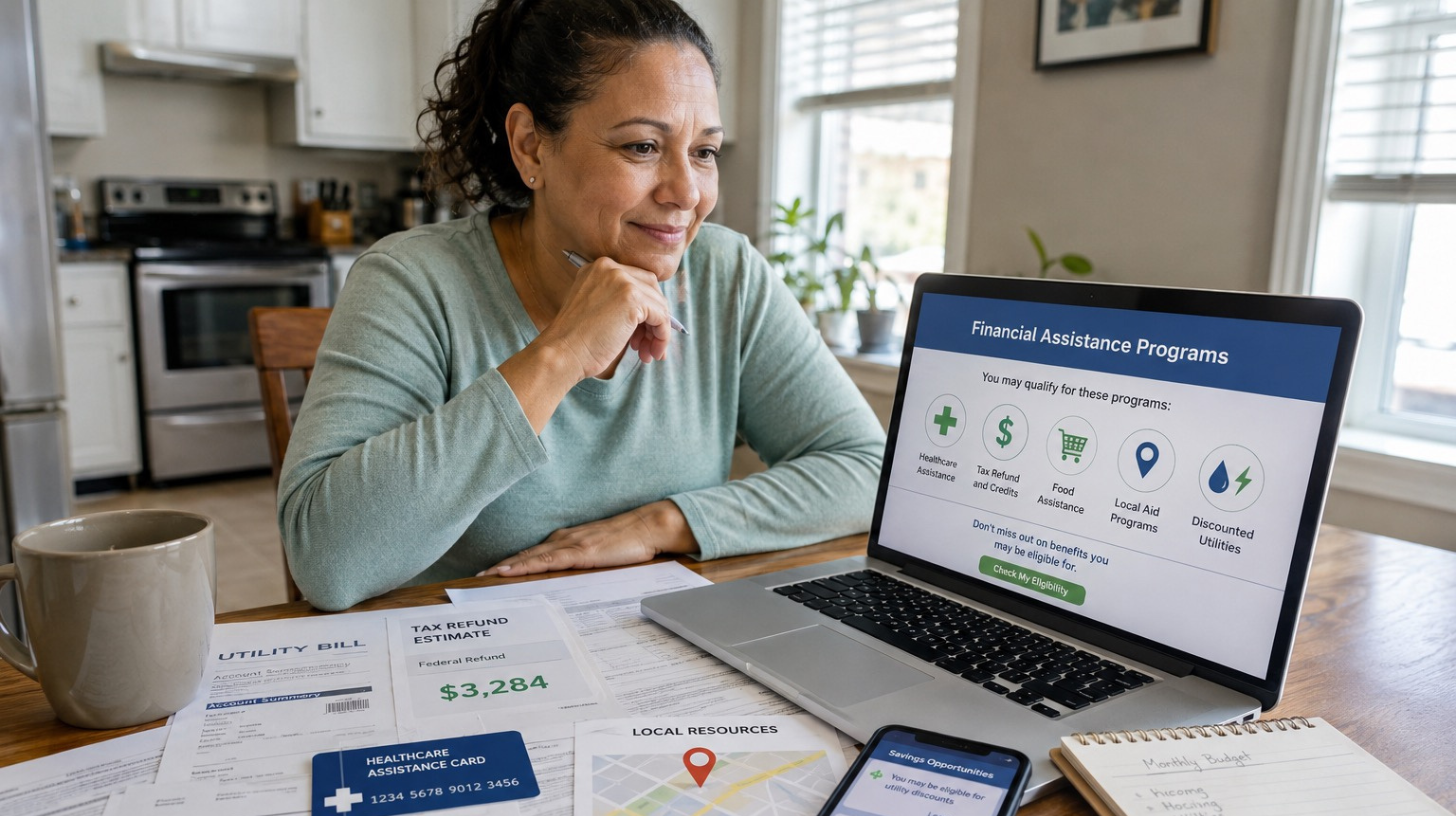
Most financial help is not hidden.
The harder problem is that it is scattered across different systems:
- Federal agencies
- State offices
- Local organizations
- Tax programs
- Employers
- Schools
- Utilities
- Health programs
That makes it easy to miss something simply because you never thought to check that category.
This is not a list of programs you definitely qualify for.
It is a practical benefits audit: the main categories worth reviewing, who each category may help, and the safest place to check current eligibility.
Where to Start Before Checking Individual Programs
If you have not reviewed benefits recently, begin with the USA.gov Benefit Finder.
It can help you identify potential government benefits based on your situation and direct you toward the agencies responsible for those programs.
Do not treat a screening result as approval. Eligibility is determined by the program itself.
- Identify the expense or situation putting the most pressure on you.
- Check that category below.
- Visit the official program or agency page.
- Check the current rules for your state and household.
- Apply only to programs that actually fit.
1. Food and Nutrition Assistance
Food programs are worth checking when grocery costs are difficult to manage, household income has fallen, a child has joined the household, or someone is pregnant or caring for a young child.
Supplemental Nutrition Assistance Program
SNAP helps eligible households buy groceries.
Eligibility depends on factors such as household size, income, certain expenses, and state rules.
One important reason not to guess: SNAP rules can differ for households with older adults or people with disabilities, and states may use additional eligibility policies.
Official starting points:
Women, Infants, and Children
WIC provides nutrition support, healthy foods, breastfeeding support, and referrals for eligible pregnant or postpartum participants, infants, and children under age five.
Households already participating in certain programs such as Medicaid, SNAP, or TANF may meet WIC's income requirement through adjunctive eligibility, depending on the program and circumstances.
If you have children, check your school district for meal programs and summer food options.
If food is needed immediately, a local food bank or 211 can help identify nearby resources while you investigate longer-term assistance.
2. Health Coverage and Medical-Cost Help
Do not stop checking health coverage simply because of one past denial.
Eligibility can change when income, household size, age, pregnancy status, disability status, or state rules change.
Medicaid provides health coverage to eligible people under state and federal rules.
Eligibility differs by state and by eligibility group.
Applications can generally be made through the state Medicaid agency or through the Health Insurance Marketplace.
CHIP provides health coverage for eligible children in families that earn too much to qualify for Medicaid but still meet their state's CHIP rules.
Income limits vary by state, which is why a national dollar estimate is not a reliable eligibility test.
If you buy health insurance through the Marketplace, household income and family size can affect whether premium assistance is available.
Use the official Marketplace rather than estimating eligibility from an old percentage or income chart.
3. Housing and Rental Assistance
Housing assistance is not one single program.
Depending on the situation, help may come from a Public Housing Agency, state housing program, local emergency fund, nonprofit, legal-aid service, or housing counselor.
For subsidized housing, start with your local Public Housing Agency and ask which programs it currently administers and whether applications or waiting lists are open.
If you are behind on rent or worried about eviction, immediate local resources may be more relevant than a long-term housing program.
Use 211 and local housing resources to identify programs that may currently be available.
4. Utility and Energy Assistance
Utility help is easy to miss because many people do not search until a bill has already become urgent.
The Low Income Home Energy Assistance Program helps eligible households with home-energy costs.
Programs are administered through states, territories, tribes, and local organizations, so application periods and rules vary.
The Weatherization Assistance Program focuses on improving home energy efficiency for eligible households rather than simply paying a current bill.
This can be worth checking when high energy costs are a recurring problem.
Lifeline is a federal program that can reduce the cost of qualifying phone or broadband service for eligible households.
5. Tax Credits People Forget to Recheck
Tax credits deserve their own review because eligibility can change from one tax year to another.
Do not rely on dollar amounts from an old article. Credits, limits, phaseouts, and refundable amounts can change.
The Earned Income Tax Credit is available to certain workers who meet current eligibility requirements.
The result can depend on income, filing status, qualifying children, and other tax-year rules.
Parents and caregivers should review the Child Tax Credit and Child and Dependent Care Credit for the tax year being filed rather than assuming last year's eligibility still applies.
6. Senior and Disability Programs
Older adults and people with disabilities may qualify for programs separate from ordinary Social Security retirement benefits.
SSI and Social Security Disability Insurance are different programs with different rules.
If you are unsure which Social Security programs may apply, use the Social Security Administration's current eligibility screening resources.
Medicare Savings Programs can help eligible Medicare beneficiaries with certain Medicare costs.
These programs are administered through states, and limits can change. State rules may also be more generous than federal minimums.
Extra Help can reduce Medicare Part D prescription-drug costs for eligible beneficiaries.
7. Programs for Families With Children
Families often miss support because food, health, childcare, school, and tax programs are spread across different systems.
If you have children, review at least these categories:
- WIC for eligible pregnant or postpartum participants and young children
- Medicaid or CHIP
- School meal programs
- Childcare assistance
- Child-related tax credits
- Head Start or Early Head Start
Check again after a new child, change in income, change in employment, or when a child reaches a new age range.
8. Local and Emergency Assistance
National benefits pages cannot tell you everything available in your county or city.
Local assistance may include:
- Emergency rent help
- Utility-assistance funds
- Food pantries
- Transportation assistance
- Childcare resources
- Community health services
- Disaster-recovery resources
Use 211 to identify resources in your area, then verify eligibility and current availability directly with the organization providing the assistance.
When Should You Check Benefits Again?
A benefits review should not be treated as a one-time event.
Recheck after:
- Job loss or reduced work hours
- A meaningful change in income
- Birth or adoption of a child
- Marriage, divorce, or household change
- Moving to another state
- A new disability or serious illness
- Retirement
- A major increase in rent, utilities, or childcare costs
- A disaster affecting your household
- A new tax-filing year
Run a broad benefits review periodically and again whenever something important changes in your household.
Frequently Asked Questions
Can I receive benefits if I am working?
Possibly. Employment does not automatically disqualify you from every assistance program. Programs use different rules involving income, household size, age, disability, expenses, state rules, and other factors. Check the current requirements for the specific program.
Should I check even if I think my income is too high?
Yes, if the program appears relevant to your situation. Do not rely on an old income figure or someone else's eligibility result. Income limits and calculation methods differ by program and can change over time.
Can I qualify for more than one program?
Potentially. Different programs can address different expenses such as food, health coverage, utilities, housing, childcare, or Medicare costs. Each program determines eligibility under its own rules.
What is the best first website to use?
If you are beginning a broad government-benefits search, USA.gov Benefit Finder is a useful starting point. It can help identify categories that may apply to your situation and direct you toward the agencies responsible for those programs.
Is Benefits.gov still the federal Benefit Finder?
No. Benefits.gov was retired. Use the current USA.gov Benefit Finder at USA.gov.
How do I know whether a benefit website is legitimate?
Identify the government agency or established organization that actually administers the program, then reach its website independently. Be cautious of sites promising guaranteed government money, charging fees simply to reveal benefits, or requesting sensitive financial information before you can verify who operates the program.