By Money Signals Editorial Team
Money Signals researches credit behavior, borrowing psychology, budgeting systems, and financial decision-making to help readers better understand how credit impacts long-term financial flexibility. Our goal is to simplify financial topics into realistic and practical guidance people can use to improve financial awareness over time.
Financial Disclaimer: This article is for informational purposes only and does not constitute financial, legal, or credit advice. Credit scoring systems vary between lenders, bureaus, financial institutions, and scoring models.
Who This Guide Is For
This guide is especially useful if you:
- Want to understand your credit situation more clearly
- Feel confused about how credit scores actually work
- Want to estimate where your credit currently stands
- Are preparing for a loan, apartment application, or financing decision
- Want to improve your credit habits gradually over time
Credit scores affect far more than many people initially realize.
They may influence:
- Loan approvals
- Interest rates
- Credit card offers
- Apartment applications
- Insurance pricing
- Financial flexibility overall
Because of that, many people search for fast ways to understand:
👉 “How good is my credit right now?”
That is why credit score estimators have become popular.
They provide:
- Quick score estimates
- Educational insights
- General credit awareness
- Scenario testing opportunities
without requiring a formal lender review.
But estimators also have important limitations.
If you are trying to understand a credit score estimator, the most important insight is this:
👉 A credit score estimator is designed to provide direction and awareness—not exact certainty about your real score or guaranteed approval outcomes.
Try the Money Signals Credit Score Estimator & Simulator
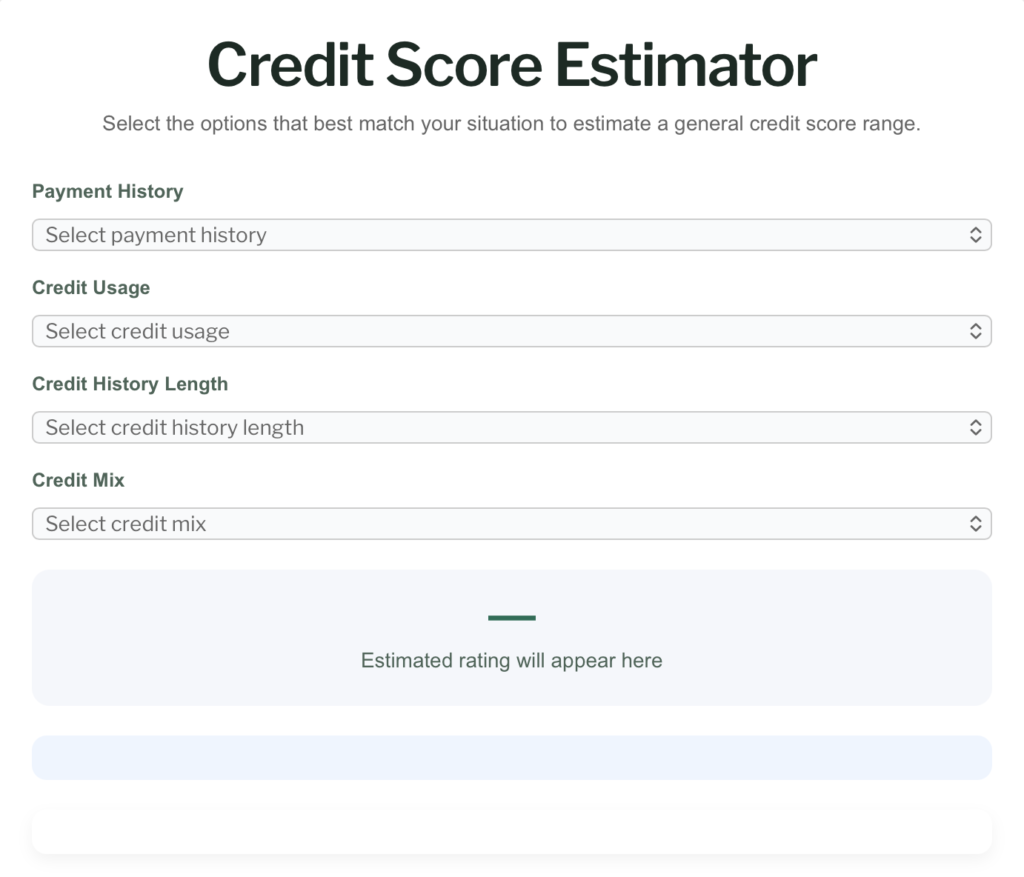
Before applying for credit products or financing, it helps to understand how different financial behaviors may affect your credit profile.
The Money Signals Credit Score Estimator & Simulator helps estimate:
- General credit score ranges
- Possible credit health categories
- The potential impact of financial behaviors
- How utilization and payment habits may affect credit trends
- Educational “what-if” credit scenarios
The tool is especially useful for:
- Beginners learning how credit works
- Exploring how financial decisions may affect scores
- Understanding the relationship between utilization and credit health
- Building broader awareness before applying for financing
One of the biggest advantages of a simulator is visibility.
Many people know:
👉 Credit matters.
But they do not fully understand:
👉 Which behaviors influence credit most strongly over time.
The estimator helps transform:
- Confusing credit concepts
into:
- More understandable financial patterns and trends.
Introduction
Credit scores often feel mysterious because most people never see:
👉 The full scoring system itself.
Instead, they see:
- A number
- A score category
- An approval or denial outcome
without fully understanding:
- Why the score changed
- Which habits matter most
- How lenders interpret risk
That uncertainty creates anxiety for many people.
Some people associate credit scores with:
- Financial judgment
- Approval fear
- Loan rejection concerns
- Financial stress overall
As a result, people often search for:
👉 Fast answers and quick clarity.
Credit score estimators help fill that gap by offering:
- Educational projections
- Approximate score ranges
- General behavioral insights
However, it is important to understand what these tools are actually designed to do.
A credit score estimator is not:
- An official bureau report
- A lender approval system
- A guaranteed predictor of financing outcomes
Instead, it is:
👉 An educational estimation tool.
Its purpose is helping users understand:
- General credit trends
- Behavioral impact
- Financial habits that may influence credit health over time
The goal is not obsessing over:
👉 One exact number.
The goal is understanding how:
- Payment behavior
- Credit usage
- Financial consistency
influence long-term financial health overall.
Why People Use Credit Score Estimators
Many people want to understand their credit standing quickly.
But official scoring systems can feel:
- Confusing
- Technical
- Difficult to interpret
That is one reason estimators have become so popular.
They provide:
- Fast approximations
- Educational feedback
- General score awareness
without requiring a formal application process.
People often use estimators before:
- Applying for loans
- Financing vehicles
- Renting apartments
- Opening credit cards
- Planning major financial decisions
The estimator becomes:
👉 A preparation tool
rather than:
👉 A final answer.
Another reason estimators matter psychologically is because many people rarely monitor their credit consistently.
Some people:
- Do not understand scoring systems fully
- Feel intimidated by financial terminology
- Want simpler educational explanations
A simulator helps make credit feel:
- More approachable
- More understandable
- Less emotionally overwhelming
Many people also use estimators to explore:
👉 “What-if” scenarios.
Examples include:
- Paying down balances
- Missing payments
- Opening new accounts
- Lowering utilization
This educational perspective helps users understand how:
👉 Financial behavior affects credit over time.
What a Credit Score Estimator Actually Does
A credit score estimator uses:
- Predictive assumptions
- General scoring principles
- User-provided financial information
to estimate a likely:
👉 Credit score range.
This distinction matters significantly.
The estimator does not directly access:
- Every lender system
- Every bureau calculation
- Every proprietary scoring model
Instead, it uses:
👉 Approximate modeling
based on common credit scoring factors.
That means the result is:
👉 An estimate—not an official score.
Different estimators may produce different results because:
- Scoring systems vary
- Lenders weigh factors differently
- Credit bureaus may calculate data differently
Even though estimators are imperfect, they still provide valuable:
- Directional awareness
- Educational insight
- Credit behavior visibility
especially for people learning how credit systems work.
The value of the estimator is not:
👉 Perfect precision.
Its value is helping users understand:
👉 How financial habits may influence credit health gradually over time.
What a Credit Score Estimator Can Tell You
Credit score estimators can still provide useful insights when interpreted realistically.
One of the most useful features is:
👉 General score range awareness.
Estimators often categorize scores into broad ranges such as:
- Poor
- Fair
- Good
- Very good
- Excellent
This creates broader financial awareness even if the exact number is not perfectly precise.
Estimators may also help identify:
👉 Credit trends.
For example:
- Lower utilization may improve estimated scores
- Missed payments may reduce estimated scores
- Reduced balances may strengthen overall credit health
This helps users recognize:
👉 Which behaviors matter most long-term.
Many estimators also allow:
👉 Scenario testing.
Examples include:
- Exploring how paying off balances may affect credit
- Estimating the impact of new accounts
- Understanding how high utilization may reduce scores
This educational perspective can improve:
- Financial planning
- Borrowing decisions
- Credit awareness overall
The Money Signals Credit Score Estimator & Simulator is especially useful for testing these broader financial behavior patterns in a simpler and more beginner-friendly format.
What a Credit Score Estimator Cannot Tell You
Credit score estimators also have important limitations.
Understanding those limitations helps prevent unrealistic expectations.
One of the biggest misconceptions is:
👉 “Estimated score = guaranteed approval.”
That is not how lending decisions work.
A lender may evaluate:
- Income
- Debt levels
- Employment history
- Existing obligations
- Credit report details
- Financial stability overall
—not only:
👉 A score estimate.
Estimators also cannot guarantee:
👉 Your exact real score.
Actual scores may vary depending on:
- Credit bureau
- Scoring model
- Reporting timeline
- Lender system
Real credit reports also change continuously.
For example:
- Payments post
- Balances update
- Accounts open or close
- Utilization fluctuates
An estimator may not reflect:
👉 Real-time reporting updates immediately.
Different lenders may also prioritize different risk factors.
For example:
- Mortgage lenders
- Auto lenders
- Credit card issuers
may all evaluate:
👉 Borrower risk differently.
That is why estimators should always be viewed as:
👉 Educational guidance tools
—not:
👉 Final lending decisions.
The Biggest Factors That Affect Credit Scores
While scoring systems vary, several major factors commonly influence credit scores.
One of the most important is:
👉 Payment history.
Late payments may strongly affect:
- Credit health
- Risk perception
- Borrower reliability
Consistency matters significantly over time.
Another major factor is:
👉 Credit utilization.
Utilization refers to:
- How much available credit is currently being used.
A simplified utilization formula looks like this:
Utilization=BalanceCredit Limit×100Utilization=Credit LimitBalance×100
Higher utilization may signal:
- Increased financial strain
- Greater borrowing risk
Credit history length also matters.
Longer histories provide:
- More behavioral information
- More repayment consistency data
Scoring systems may also evaluate:
- Credit mix
- New account activity
- Recent applications
The important long-term insight is this:
👉 Credit scores are usually influenced more by:
- Repeated responsible behavior
than: - Short-term optimization tricks.
How to Use the Money Signals Credit Score Estimator Effectively
Using the Money Signals Credit Score Estimator & Simulator effectively means focusing on:
👉 Long-term financial awareness
instead of:
👉 Emotional score obsession.
The healthiest approach is using estimators for:
- Education
- Pattern recognition
- Behavioral insight
rather than checking constantly for tiny score changes.
The simulator becomes especially useful when testing:
👉 Financial behavior scenarios.
Examples include:
- Paying down balances
- Lowering utilization
- Avoiding missed payments
- Exploring the impact of additional credit activity
The goal is understanding:
👉 Directional improvement.
The exact score matters less than whether your overall:
- Payment behavior
- Debt management
- Financial consistency
are improving gradually over time.
It is also important to combine estimation tools with:
👉 Real credit monitoring whenever possible.
Reviewing official reports periodically may help identify:
- Reporting errors
- Fraudulent accounts
- Incorrect balances
Using estimators responsibly creates:
- Better financial awareness
- Reduced confusion
- More intentional financial habits overall.
How to Improve Your Credit Gradually
Strong credit usually develops through:
- Time
- Consistency
- Responsible account management
—not quick fixes.
One of the most important habits is:
👉 Paying bills consistently.
Reliable payment history strongly affects:
- Credit stability
- Lender confidence
- Long-term score improvement
Reducing high utilization may also improve:
- Risk perception
- Overall credit health
Avoiding unnecessary new credit applications may help reduce:
- Short-term risk signals
It is also important to review credit reports periodically for:
- Errors
- Incorrect balances
- Fraudulent activity
Many people become vulnerable to scams promising:
👉 “Fast credit repair.”
Be cautious of:
- Unrealistic guarantees
- Aggressive credit repair claims
- Expensive quick-fix services
Meaningful long-term credit improvement usually happens gradually through:
- Better financial habits
- Consistency
- Time
The goal is not creating:
👉 A perfect score overnight.
The goal is building:
👉 Stronger long-term financial behavior.
FAQs About Credit Score Estimators
Are credit score estimators accurate?
They may provide reasonable approximations, but they are not guaranteed exact scores.
Why is my real score different from the estimate?
Different scoring models, bureaus, and reporting timelines may produce different results.
Does checking my estimated score hurt my credit?
Most educational estimators use soft inquiries, which generally do not affect credit scores.
Can I improve my credit quickly?
Some improvements may happen relatively quickly, but meaningful long-term improvement usually takes time and consistent financial habits.
Should I check my score constantly?
Usually no. Long-term trends and financial behavior matter more than frequent short-term score monitoring.
The Bottom Line
Credit score estimators are useful:
👉 Educational tools.
They help provide:
- General score awareness
- Financial behavior insight
- Credit trend visibility
- Scenario testing opportunities
But they are not:
- Exact scoring systems
- Guaranteed approval predictors
- Perfect representations of lender decisions
The Money Signals Credit Score Estimator & Simulator helps transform confusing credit concepts into:
- More understandable financial patterns
- Better behavioral awareness
- Clearer long-term financial insight
The goal is not obsessing over:
👉 A single number.
It is understanding how:
- Payment habits
- Credit usage
- Financial consistency
influence long-term financial health over time.
Because strong credit usually develops through:
👉 Awareness, consistency, and responsible financial behavior repeated over time.
Start Here (Simple Action Step)
Take 15–20 minutes this week:
- Open the Money Signals Credit Score Estimator & Simulator
- Explore how utilization and payment behavior may affect credit estimates
- Identify one financial habit you could improve consistently
- Focus on long-term behavior instead of short-term score obsession
- Review your real credit reports periodically when possible
👉 Financial awareness becomes much more useful once credit stops feeling mysterious and starts feeling understandable.
Related Articles
→ How to Spot Bank Fees You Can Avoid
Reduce unnecessary financial costs that affect cash flow
→ How to Lower Recurring Bills Without Changing Everything
Improve financial flexibility through recurring expense optimization
→ Beginner-Friendly Ways to Make Extra Money That Actually Work
Explore practical ways to increase income and improve financial stability
Simple Insight to Remember
A credit score estimator is not designed to predict your future perfectly—it is designed to help you understand how financial behavior may influence long-term credit health over time.